On this page

The Best Bikepacking Frame Bags

The frame triangle is the best place on a bicycle to carry weight, and the only place where using it costs you something you already rely on. That trade is the whole decision.

Published September 8, 2026
Edited by Louis Raveton
When you purchase through links on our site, we may earn an affiliate commission. Here's how it works.
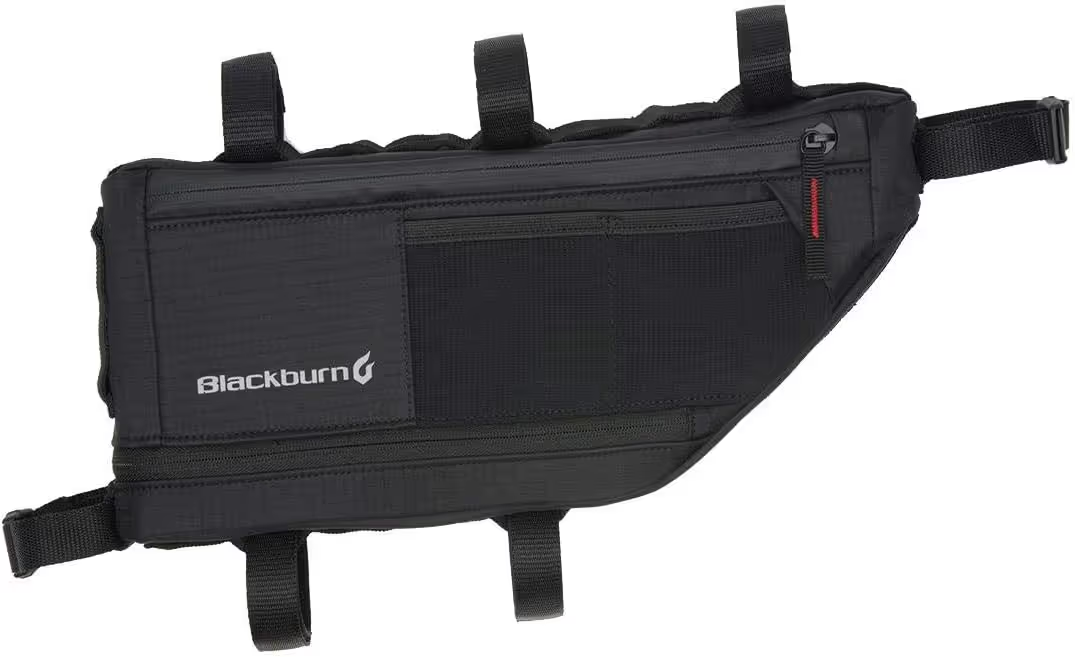
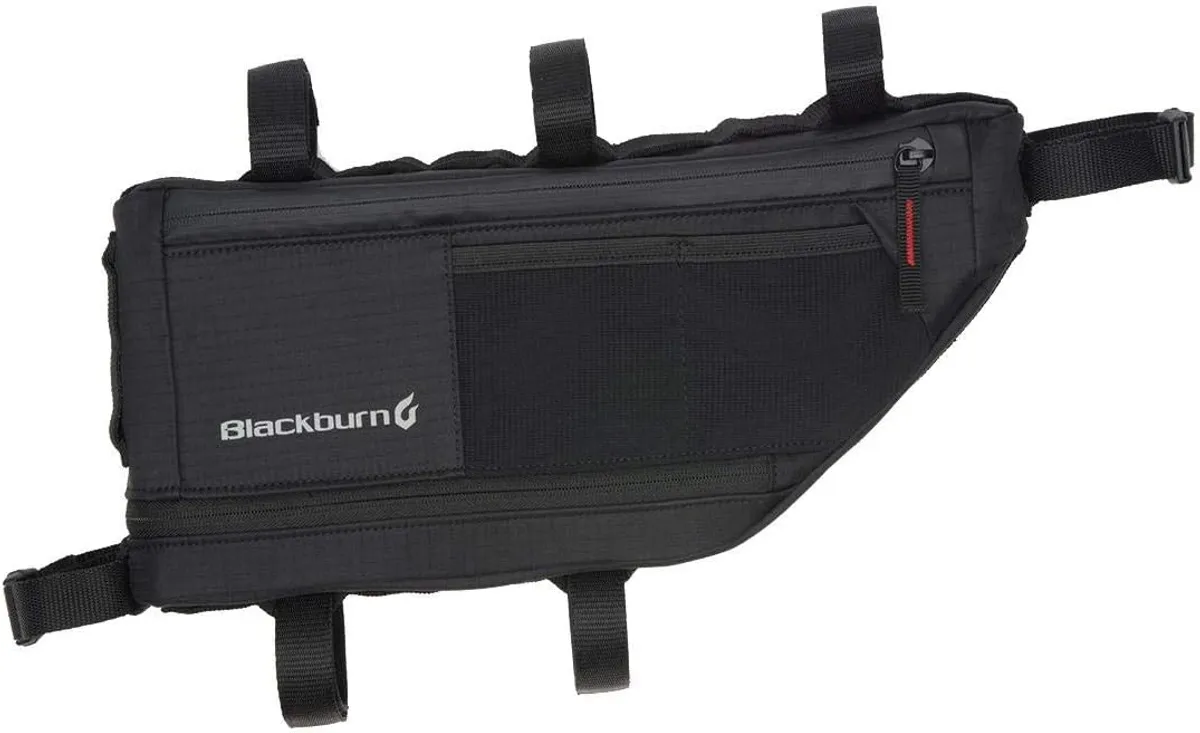
Blackburn Outpost Frame Bag (Medium), our top pick in The Best Bikepacking Frame Bags

Weight in the frame triangle sits low, central and between the wheels, which is why a loaded frame bag changes handling less than any other bag on the bike. Four kilos in the frame is barely noticeable. Two kilos on the handlebars is not.

The catch is that the triangle already has a job. Your bottle cages live there, and a full-frame bag takes all of it. That single decision splits this list in two.

Seven bags here, from an $18 half-frame to an $85 premium one. Some links are affiliate links, which is how the site pays for itself, and none of them changed a score.

Editor's Choice

  • • Expands from 4.3 to 5.8 L in the Medium
  • • Opens from both sides, with a divider
  • • 4.7 stars from 885 owners
$59.95
Checked Aug 2026
Buy on Amazon

Quick Comparison

Sort
Best for Frame Storage
  • Capacity 2 litres
  • Mounting Three straps, top tube and head tube
  • Material Water-resistant polyester
  • Access Single top zip
Best for Frame Storage
  • Type Under-top-tube wedge
  • Capacity 3 L (a 4 L version is on the same listing)
  • Weight 198 g (listing)
  • Size 40.5 x 12.5 x 6 cm (listing)
Best for Frame Storage
  • Capacity 2.5 L (Medium)
  • Weight 181 g (6.4 oz, Amazon listing)
  • Dimensions 30 x 19 (max) x 6 cm
  • Material Nylon, water-repellent
Best for Full Frame
  • Capacity 6.5L, 12L or 14L by size
  • Fit Road and gravel frame geometry
  • Mounting Multi-point strap mount
  • Access Full-length zip
Best for Full Frame
  • Type Full-frame
  • Capacity 8.5 L (Large), 7 L (Medium)
  • Weight 275 g (Large, listing)
  • Size Sized by frame, check the chart
Best for Frame Storage
  • Type Half-frame, expanding base
  • Capacity 4.3 L, 5.8 L expanded (Medium)
  • Weight Not published
  • Size 17.8 cm deep, 27.9 cm expanded (retailer)
Best for Frame Storage
  • Size Small
  • Mounting Strap mount with reinforced anchors
  • Material Weather-resistant, reinforced panels
  • Warranty Osprey All Mighty Guarantee

The Bag Most Riders Should Buy

A dual-sided half-frame bag in heavy fabric, around 30 dollars.

It keeps your bottle cages, separates tools from the things you reach for, and 840D nylon survives the abrasion that ends cheaper bags. For the overwhelming majority of riders adding a third bag to a seatpack and a bar roll, this is the correct purchase and the decision does not need more thought than that.

Spend 18 dollars instead if you are not yet sure a frame bag suits your riding. Spend 60 if a budget bag has already failed to fit around your cable routing, which is a real problem on some frames and the main thing the mid-tier bags solve.

When A Full-Frame Bag Is Worth It

The honest threshold is weight, not capacity.

If your seatpack is stuffed to the point where the bike sways out of the saddle, moving four kilos into the triangle fixes it in a way no amount of strap tightening will. That is the moment a full-frame bag earns its place, and riders who cross it rarely go back.

Below that threshold it costs you the bottle cages and buys you space you did not need. Fork cages and a bar-mounted bottle are the usual answer, which is another 60 dollars and two more things bolted to the bike.

Related Read

How to Pack a Frame Bag Without Wrecking the Handling

The frame bag is the only place weight is genuinely free. Here is what belongs in it, what does not, and the packing order that keeps the bike steady.

Where Each One Gives Out

The budget bags are water-resistant, and the zip is the leak. An hour of light rain is the realistic limit, so anything that must stay dry needs its own dry bag inside.

The full-frame bags have to be sized to your triangle, and getting it wrong leaves dead space that lets the load shift. Measure before ordering rather than after.

The premium bags cost four to five times the budget ones and carry no more. What they buy is mounting flexibility on awkward frames and a warranty, which is worth it for a bag that lives on the bike permanently and hard to justify for one that comes out twice a year.

And all of them will mark your paint where they touch. Tape the contact points on day one.

Related Read

Fixing Frame Bag Rub: How to Save Your Paint (And Your Straps)

A loose frame bag sands through paint in 20 miles. How to stop frame rub and harness movement before the damage reaches carbon or bare metal.

Our Recommendations

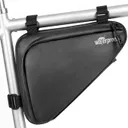
NDakter // Best For Frame Storage //
★ 4.5 (2,491 ratings at the retailer)

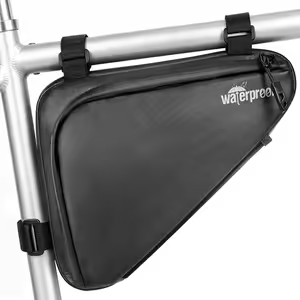
NDakter Bike Frame Bag (2L)
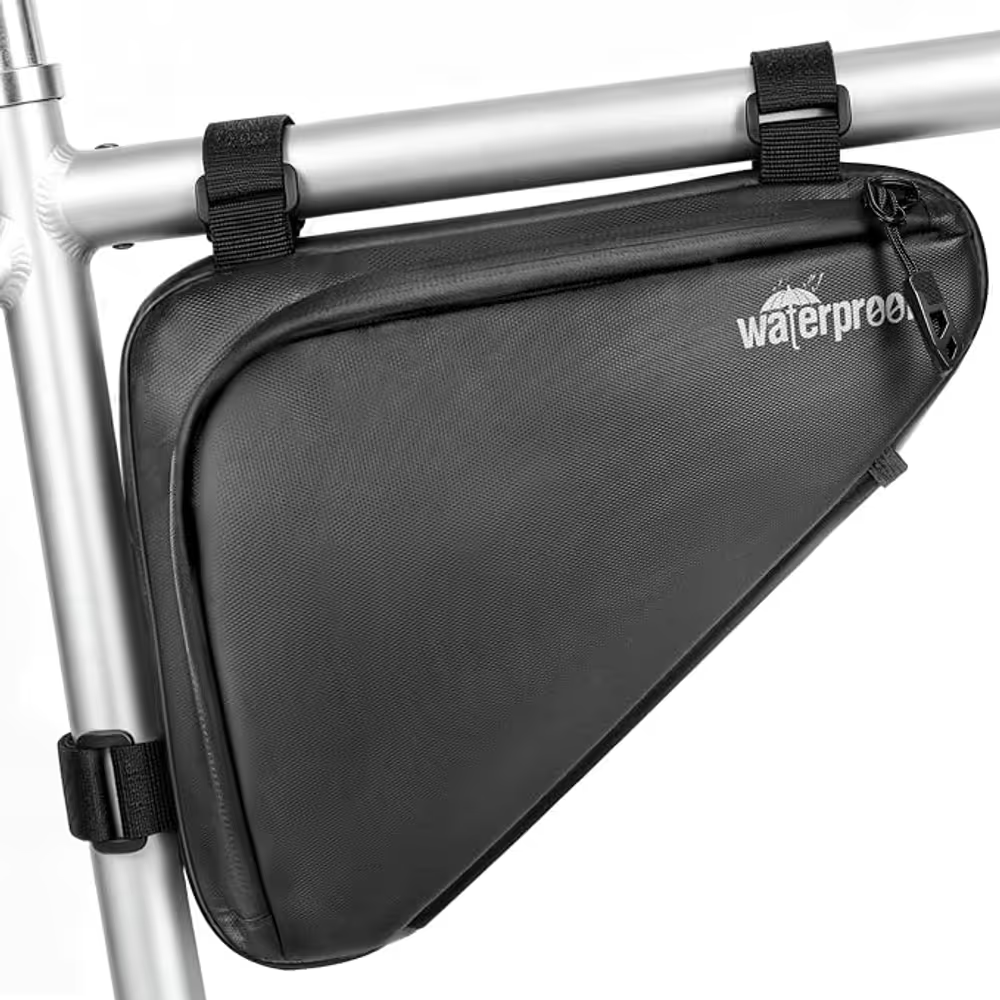
Product shot of NDakter Bike Frame Bag (2L) by NDakter
Best For Frame Storage

Tech Specs

Capacity
2 litres
Mounting
Three straps, top tube and head tube
Material
Water-resistant polyester
Access
Single top zip
Eighteen dollars, 2 litres, and it does not sag onto your knees.

This is a half-frame bag, meaning it fills the top of the triangle and leaves the bottle cages usable, which for most riders is the correct compromise. Two litres holds a pump, a tube, tools and a phone without pushing into the space your knees swing through. The three-strap mount fixes it to the top tube and head tube, and owner reports are consistent that it stays put once tensioned properly.

Read the full review

The structure is the reason it stands out at this price. Cheaper bags collapse into the frame once loaded, which turns a tidy bag into something that rubs the paint and catches your leg. Reports here describe it holding shape well enough that the shape is not the complaint.

It is water-resistant rather than waterproof, which in practice means an hour of light rain and no more. The zip is the entry point and it has no storm flap. Anything inside that must stay dry needs a bag of its own, which at this price is a fair trade rather than a fault.

One practical note from the reports: the straps benefit from a second tension check after the first hour of riding, because the webbing beds in and a bag that felt solid in the garage can start to move. After that they hold. Trimming the excess strap and taping the tails stops the flapping that otherwise develops on rough surfaces.

Full review, score breakdown & specs

The Verdict

The right first frame bag. Sags less than its price suggests, keeps rain out for an hour, and costs little enough that outgrowing it is not a problem.

GravelPacker score How we score
4.0/5
Durability
3.5
Performance
3.5
Usability
4
Value
5
  • • Holds its shape under load, unlike most bags at this price
  • • Leaves bottle cages usable
  • • Very well evidenced in owner reports

$17.99
Checked Aug 2026
Buy on Amazon

The Good

  • + Holds its shape under load, unlike most bags at this price
  • + Leaves bottle cages usable
  • + Very well evidenced in owner reports
  • + Cheap enough to buy before committing to a system

The Bad

  • − Water-resistant only, and the zip leaks first
  • − No internal organisation beyond one compartment
  • − Straps need re-tensioning over the first few rides
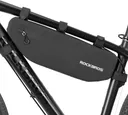
ROCKBROS // Best For Frame Storage //
★ 4.5 (1,705 ratings at the retailer)

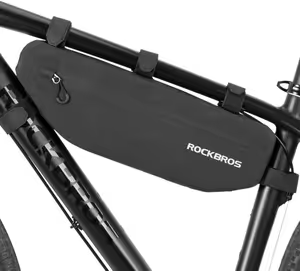
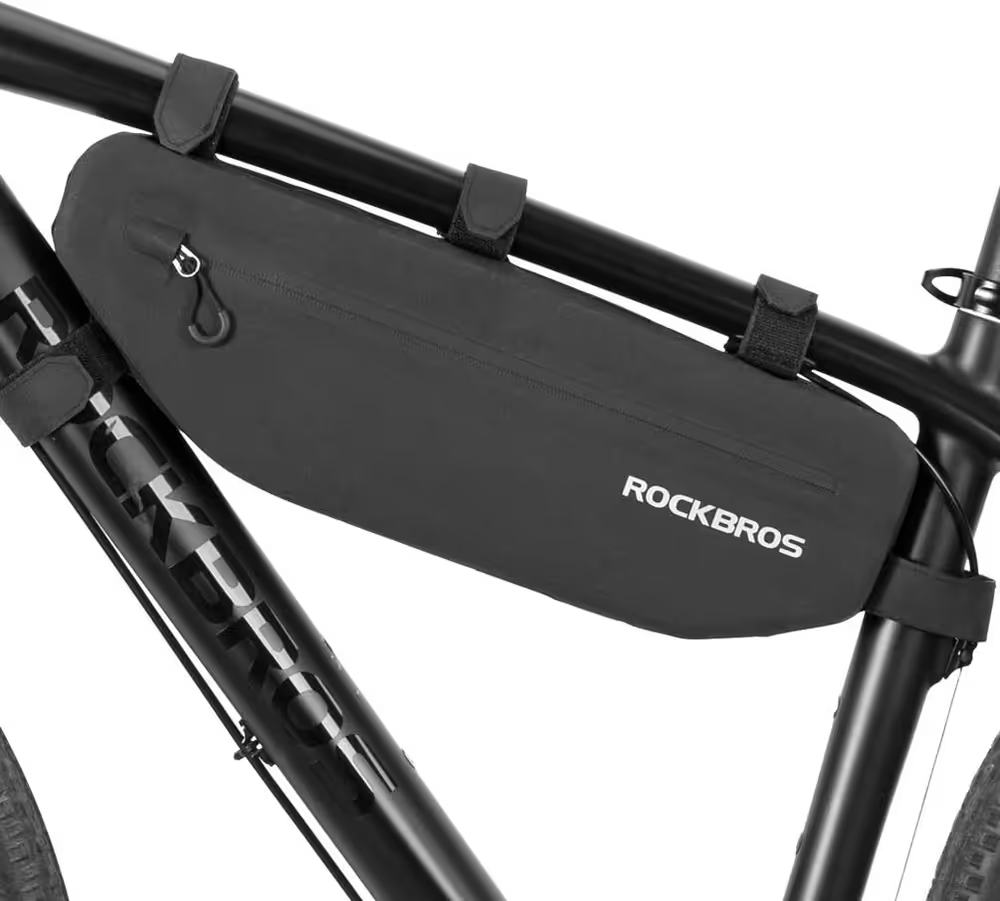
ROCKBROS 840D Nylon Bike Triangle Bag (3L)

Product shot of ROCKBROS 840D Nylon Bike Triangle Bag (3L) by ROCKBROS
Best For Frame Storage

Tech Specs

Type
Under-top-tube wedge
Capacity
3 L (a 4 L version is on the same listing)
Weight
198 g (listing)
Size
40.5 x 12.5 x 6 cm (listing)
Material
840D nylon, heat-pressed
Layout
A zipped compartment on each side
Mounting
5 hook-and-loop straps, 11 mounting holes
This is a small wedge bag rather than a frame filler. It holds tools, spares and snacks under the top tube, and on most frames leaves room for bottles below.

The listing gives the 3 litre version as 40.5 cm long, 12.5 cm deep and 6 cm wide, at 198 g. It is a wedge that hangs under the top tube rather than a bag that fills the triangle, held by five hook-and-loop straps with 11 mounting holes to choose from. A rigid plate keeps its shape, and there is a zipped compartment on each side.

Read the full review

That shape is the reason to choose it. On a medium or large frame the bottle cages usually stay in use, and one owner keeps two bottles on a 58 cm frame. ROCKBROS itself warns that it can foul bottle cages on some frames, so measure the space under the top tube before ordering, and look at the 4 litre version on the same listing if there is room.

The fabric is heat-pressed 840D nylon, and ROCKBROS claims it keeps out 95 percent of water. Owner reports on water split almost evenly in Amazon's review summary, with one owner finding water pooling inside, so treat it as shower-resistant and bag anything that must stay dry. Hook-and-loop straps can mark paint, so protect the contact points.

Zips are the weak point in the owner record. Amazon's summary counted 28 negative zip mentions out of 37, and owners describe failures after six months, 16 months and about two years. Owners on Amazon US gave it 4.5 stars from 1,705 ratings in October, with about 3 percent at one or two stars.

Full review, score breakdown & specs

The Verdict

A cheap, light wedge that keeps the bottles in play on most frames. Expect the zips to be the first thing to go.

GravelPacker score How we score
3.9/5
Durability
3.5
Performance
3.5
Usability
4
Value
4.5
  • • 198 g and leaves room for bottles on most frames
  • • A compartment on each side
  • • 11 strap positions for different tubes
$29.99
Checked Aug 2026
Available with Amazon Prime
Buy on Amazon

The Good

  • + 198 g and leaves room for bottles on most frames
  • + A compartment on each side
  • + 11 strap positions for different tubes

The Bad

  • − Zips are the common failure
  • − Water resistance is a claim, and reports are split
  • − Only 3 L, not a frame filler
ROCKBROS // Best For Frame Storage //
★ 4 (85 ratings at the retailer)

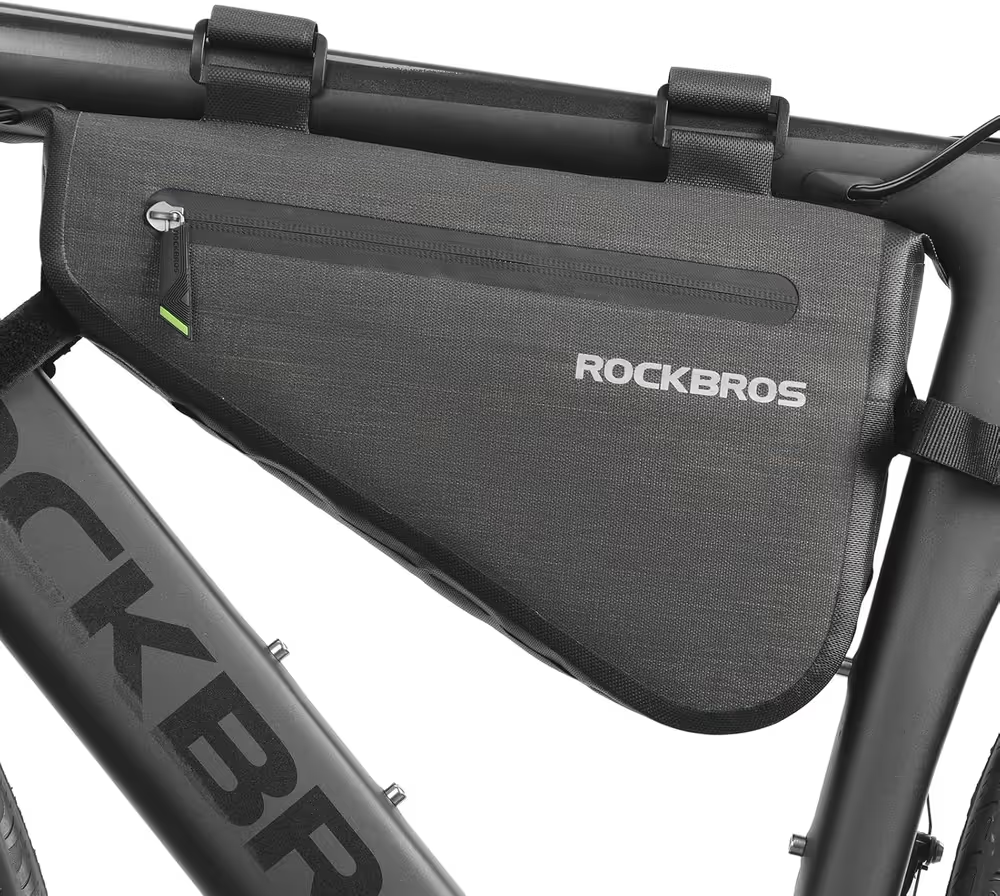
ROCKBROS Triangle Frame Bag (2.5 L)

Product shot of ROCKBROS Triangle Frame Bag (2.5 L) by ROCKBROS
Best For Frame Storage

Tech Specs

Capacity
2.5 L (Medium)
Weight
181 g (6.4 oz, Amazon listing)
Dimensions
30 x 19 (max) x 6 cm
Material
Nylon, water-repellent
Mounting
Four straps
2.5 litres in a 6 cm wide wedge at 181 g. Water-repellent, so keep the phone in a zip bag.

The Amazon US listing sells this as the Medium 2.5 litre bag, 30 cm long, 19 cm at its deepest tapering to 6.9 cm, and 6 cm wide, at 6.4 oz (181 g). It hangs under the top tube on four straps and opens by a main zip, with a zipped side pocket for small items. A Large 4 litre version, 40 by 23 cm, sits on the same listing for bigger frames, so measure your triangle before ordering.

Read the full review

The title says waterproof, but the bullets describe water-repellent fabric and zips and tell you not to soak it in heavy rain. Treat it as a bag for a shower, and put a phone or a battery in a zip bag inside it on a wet day. At 6 cm wide it clears the knees, though one owner found it left room for only one bottle cage.

Owner reports stood at 4.0 stars across 85 ratings in October 2026, with 11 percent at one star. The sharpest complaint was a zip that stuck on its waterproof lip and came apart on the first day, and another owner found the strap positions awkward on an e-bike top tube. At $37.99 from ROCKBROS it is not the cheapest half-frame bag, so the slim profile is what you are paying for.

Full review, score breakdown & specs

The Verdict

A slim, light half-frame bag for fair-weather riding. The zip and the rain are its limits.

GravelPacker score How we score
3.5/5
Durability
4
Performance
3.5
Usability
3.5
Value
3
  • • 6 cm wide, clears the knees
  • • 181 g for 2.5 litres
  • • Zipped side pocket for small items
$37.99
Checked Oct 2026
Buy on Amazon

The Good

  • + 6 cm wide, clears the knees
  • + 181 g for 2.5 litres
  • + Zipped side pocket for small items

The Bad

  • − Water-repellent, not for heavy rain
  • − Owner report of a zip failing
  • − May leave room for one bottle

Also rated

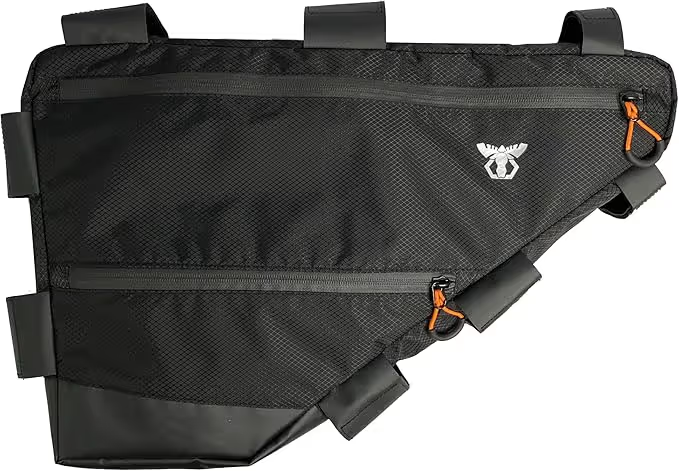
4. Moosetreks

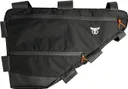
Moosetreks Touring Road Bike Full Frame Bag

4.1 /5

This is one of the few genuinely full-frame bags available at a sane price, and the road and gravel cut matters because a full-frame bag only works if it matches the triangle.

Capacity
6.5L, 12L or 14L by size
Fit
Road and gravel frame geometry
Mounting
Multi-point strap mount
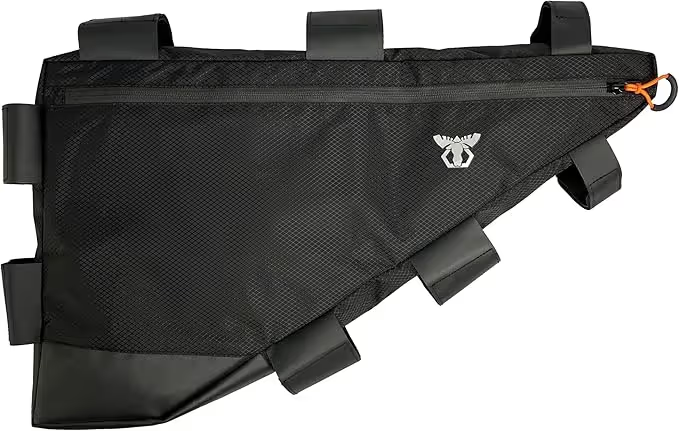
5. Moosetreks

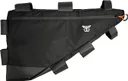
Moosetreks Trail Full Frame Bag (Large)

4.0 /5

The Trail is Moosetreks' full-frame bag for mountain and adventure geometry. It is the cheapest way here to fill a whole front triangle, if the frame shape suits it.

Type
Full-frame
Capacity
8.5 L (Large), 7 L (Medium)
Weight
275 g (Large, listing)
6. Blackburn

Blackburn Outpost Frame Bag (Medium)

4.3 /5

The Outpost is a half-frame bag that sits between the budget wedges and the full-frame bags. Its case is capacity that expands when needed and the strongest owner record of the three here.

Type
Half-frame, expanding base
Capacity
4.3 L, 5.8 L expanded (Medium)
Weight
Not published
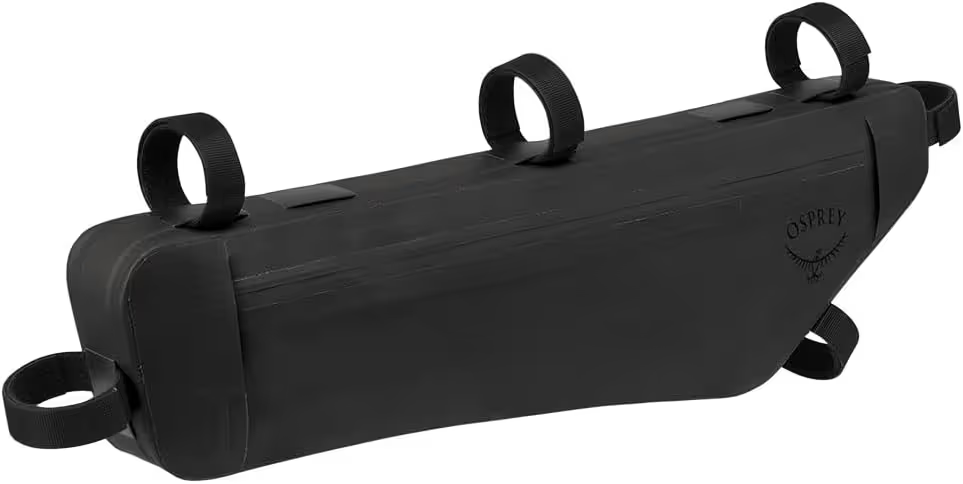
7. Osprey

Osprey Escapist Bike Frame Bag (S)

3.9 /5

The Escapist is priced against boutique bikepacking brands and justifies it through construction quality and a guarantee that covers essentially everything.

Size
Small
Mounting
Strap mount with reinforced anchors
Material
Weather-resistant, reinforced panels
Buying Advice

What to look for

Four things decide this, and capacity comes last.

1. Half frame or full frame

A half-frame bag fills the top of the triangle and leaves the bottle cages usable, which suits most riders on most trips. A full-frame bag takes the lot, carries far more, and forces water onto the fork or the bars. Choose this first, because everything else follows from it.

2. Width, not volume

The specification nobody reads is how far the bag protrudes from the frame. Anything much over 6 cm starts catching the inside of your knees on every pedal stroke, and a bag you clip constantly is a bag you stop using. Narrow and long beats short and fat.

Related Read

How to Pack a Frame Bag Without Wrecking the Handling

The frame bag is the only place weight is genuinely free. Here is what belongs in it, what does not, and the packing order that keeps the bike steady.

3. Fabric denier decides how long it lasts

A frame bag spends its life rubbing against a top tube. 600D polyester is the budget standard and 840D nylon is a genuine step up, and the difference shows as abrasion after a couple of seasons rather than as anything you notice on day one.

4. Mounting points, if your frame is awkward

Three straps work on a simple frame. Cable stops, dropper posts and bottle bosses defeat them, which is what you are paying for when a bag costs double and offers eight attachment points instead of three.

Related Read

Fixing Frame Bag Rub: How to Save Your Paint (And Your Straps)

A loose frame bag sands through paint in 20 miles. How to stop frame rub and harness movement before the damage reaches carbon or bare metal.

Methodology

How we chose

A desk selection from published specifications and owner reports. GravelPacker does not run a test lab, so the checks below are ones a specification and a large body of reviews can answer.

1. Protrusion width, from published dimensions

Where a maker publishes the width, it is compared against the roughly 6 cm at which knee contact starts. Where it is not published, owner reports about leg rub are treated as the evidence, and their absence is not read as a pass.

2. Fabric denier against expected life

600D and 840D are compared on the axis that matters for this bag, which is abrasion against the top tube rather than tear strength. Manufacturer waterproofing claims are read as water resistance unless seams are stated to be welded.

3. Mounting against real frame obstructions

Attachment point counts and adjustability are assessed against the things that actually defeat a frame bag: cable stops, dropper routing and bottle bosses. Bags sized generically are marked down where a sized alternative exists.

4. Failure modes, from the one- and two-star reviews

Zip failure under overpacking, strap anchors tearing out, and paint rub are what frame bags die of, and all three surface in reviews written months after purchase rather than in first impressions.

Q&A

Frequently Asked Questions

Half-frame or full-frame bag for bikepacking?

Half-frame for most riders. It keeps your bottle cages, holds enough for tools, a tube and a phone, and costs a fraction as much. Go full-frame when you are carrying enough weight that handling has become the problem, and accept that water then has to live on the fork or the bars.

Will a frame bag rub the paint off my frame?

Yes, eventually, wherever it contacts. Helicopter tape or clear protection film under the contact points costs a few dollars and prevents it entirely. This is worth doing when the bag is new rather than after you notice the marks.

How do I stop a frame bag hitting my knees?

Buy narrow rather than large. Anything protruding much beyond 6 cm from the frame will catch the inside of your knees, and no amount of careful packing fixes a bag that is simply too fat. Packing heavy items low and towards the bottom bracket also keeps the profile tighter.

Are frame bags waterproof?

Almost none of them, whatever the listing says. Water-resistant is the honest description for everything on this list, and the zip is where it gets in first. Anything that must stay dry goes inside a dry bag within the frame bag.

Can I still use bottle cages with a frame bag?

With a half-frame bag, usually yes, though you may need side-entry cages or to move a bottle to the down tube underside. With a full-frame bag, no. That is the trade, and it usually pushes riders towards fork-mounted cages or a bottle on the bars.

What should actually go in a frame bag?

Heavy, dense things you do not need often. Tools, a tube, a pump, a spare battery, food. The frame is where weight has the least effect on handling, so it is the wrong place for a light bulky jacket and the right place for anything that would upset a bar bag.

Keep Riding

More Bags →
Reviewer

The GravelPacker Desk

GravelPacker is a research desk, not a test lab. We read the spec sheets, the long-run owner reports and the forum threads where things break, then score what survives that reading against a rubric we publish. We say so plainly because a review you can check is worth more than one you have to trust.