Cooking
The Best Bikepacking Stove and Cook Kit (2026)
Stoves, pots, utensils and the one luxury worth its weight. Eight pieces, judged on what a bike actually has room for.
Riders new to multi-day routes tend to solve food anxiety by carrying more of it. The result is a bike loaded with three days of calories rolling past a supermarket on the first afternoon.
Food is the heaviest consumable on the bike after water, and unlike water it can usually be bought within a few hours of anywhere. Treating it as something to be carried, rather than something to be collected, is what makes a setup feel sluggish for no return.
The planning question is not how much food the trip needs in total. It is how far away the next place is that reliably sells food, and what the plan is if that place turns out to be shut.
Open the route and mark every town, shop, cafe and petrol station on it. That map, not a packing list, decides what goes in the bags.
Reliable resupply means a shop that will be open when you reach it. A village store with unpublished hours on a Sunday is not resupply, and neither is a cafe you are likely to arrive at after closing. Petrol stations and supermarkets in larger towns are the dependable end of the scale.
From there, the rule is simple: carry enough to reach the next reliable stop, plus one meal that does not depend on anything being open. That contingency meal is the whole insurance policy, and it is far lighter than the four-day pantry it replaces.
Long remote sections invert this. If the route has a 200-kilometre gap with nothing on it, that gap dictates the load and everything before it should be eaten rather than carried.
Density is the first filter. Food that carries a lot of calories per gram is worth space; food that is mostly water and packaging is not. Nuts, hard cheese, cured meat, chocolate, olive oil and dried fruit sit at the good end.
Robustness is the second. A frame bag compresses whatever is in it against the bike for hours, so anything that crushes into crumbs or melts into the seams is a poor traveller. Tortillas survive where bread does not.
The third filter is whether it can be eaten without a production. Food that needs boiling water, a bowl, a spoon and ten minutes will be skipped when it is raining, and the day it gets skipped is the day the calories were most needed. Something edible straight from the bag, at the roadside, in bad weather, is worth more than a better meal that requires setting up.
A cooking kit is one of the more debated pieces of the setup, and the honest answer depends almost entirely on the route.
On a populated route with cafes and shops, a stove mostly heats water that could have been bought hot. That is a kilo or so of stove, fuel, pot and lighter carried for convenience rather than need.
It changes in three cases. Cold weather makes a hot meal genuinely restorative rather than merely pleasant. Remote routes remove the alternative entirely. And for some riders a hot coffee before moving is the difference between a good start and a grim one, which is a legitimate reason even if it is not a logistical one.
If the answer is yes, the kit should be small enough that it does not distort the rest of the load. A single pot, a compact burner and a fuel canister sized to the trip covers almost everything a rider actually cooks on a route.
The Best Bikepacking Stove and Cook Kit (2026)
Stoves, pots, utensils and the one luxury worth its weight. Eight pieces, judged on what a bike actually has room for.
Food splits into two categories that belong in different places.
The day's eating — the bars, nuts and anything meant to be consumed while moving — goes in a top tube bag or a feed bag on the bars. If reaching food requires stopping, unbuckling and rummaging, it will not be eaten often enough, and under-eating is a bigger problem on day two than a slightly heavier bag.
Bulk food goes in the frame bag. It is dense, which is exactly what the main triangle wants, and the bag keeps it out of the sun and off the ground at camp. It is also the one place where a couple of kilos has almost no effect on how the bike handles.
What does not work is food in the seat pack. That bag is packed once in the morning and opened at camp, and anything inside it is effectively unavailable for the whole riding day.
How to Pack a Frame Bag Without Wrecking the Handling
The frame bag is the only place weight is genuinely free. Here is what belongs in it, what does not, and the packing order that keeps the bike steady.
Food can be improvised. Water cannot, and the two get planned together because both come from the same stops.
The same route map that marks shops should mark taps, fountains, streams and anywhere a bottle can be filled. Distance between reliable water, not total capacity, is what determines how much needs carrying, and that number changes enormously with temperature.
A filter shifts the calculation. Where the route crosses streams, a filter turns a long dry stretch into a short one and saves carrying several kilos of water that was available the whole time. On a route with taps every thirty kilometres it is dead weight.
The single most effective habit costs nothing and carries nothing: eat a full meal wherever food is bought, rather than packing it to eat later.
Calories eaten at the shop are calories not carried up the next climb. A hot meal in a cafe at midday does more for the afternoon than the same food eaten cold from a bag two hours later, and it takes weight off the bike immediately rather than gradually.
It also solves the resupply arithmetic. If every stop includes a meal on the spot, the food actually being carried is only ever the gap between stops, which is the lightest the bike can honestly be.
Carry to the next reliable resupply, not to the end of the trip. On a route through towns that means a day of food and no more. On a remote section it means counting days and adding one contingency meal. The common error is packing for the whole trip on day one and hauling four days of calories past three supermarkets.
Not on a route with cafes and shops. A stove earns its weight when the route is remote, the weather is cold, or morning coffee genuinely changes whether the day starts well. On a summer weekend through populated country it is usually a kilo of kit boiling water you could have bought.
Far more than most riders plan for, and the deficit shows up on day two rather than day one. Rather than counting precisely, plan on eating roughly twice a normal day's food and treat any resupply stop as a chance to eat a full meal on the spot instead of carrying it.
Dense, robust and edible without preparation. Nuts, hard cheese, cured meat, tortillas, dried fruit and bars survive being compressed in a frame bag. Anything that crushes, melts or needs a bowl and a spoon costs more than it gives.
The day's food goes in a top tube bag or feed bag where it can be reached while moving. Bulk food goes in the frame bag, which is dense-load territory and keeps it out of the sun. Nothing edible belongs in a seat pack you have to unstrap to open.
Stoves, pots, utensils and the one luxury worth its weight. Eight pieces, judged on what a bike actually has room for.
Grams and calories per day, why four days is the practical ceiling on a bike, and how to plan a route around resupply instead of hauling a week of dinners.
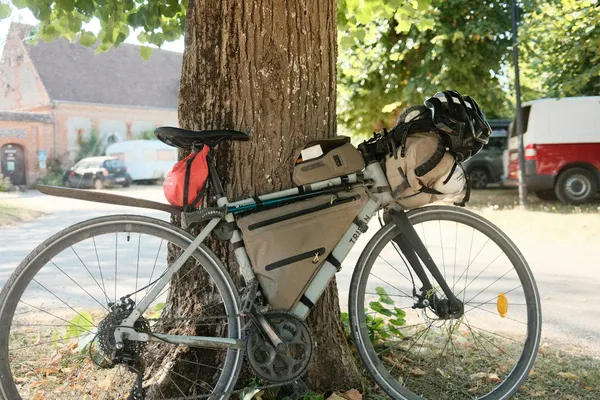
The frame bag is the only place weight is genuinely free. Here is what belongs in it, what does not, and the packing order that keeps the bike steady.

GravelPacker is a research desk, not a test lab. We read the spec sheets, the long-run owner reports and the forum threads where things break, then score what survives that reading against a rubric we publish. We say so plainly because a review you can check is worth more than one you have to trust.