Bags
Rhinowalk vs Rockbros: Are the Amazon House Brands Different?
We have scored 16 bags across both brands. Their average scores differ by 0.08, but they are not interchangeable, and where they overlap the cheaper one wins.
Five years ago the answer to this question was different. The fabric and the closure were the weak points and a wet weekend proved it.
That has changed. TPU-laminated shells and proper roll-top closures are standard at 25 dollars now, and a budget bag closed with three tight turns will keep a sleeping bag dry through a day of rain. Across the specifications and the owner reports this is genuinely no longer the differentiator, and anyone still saying cheap bags leak is working from old information.
Some of them ship with air purge valves, which is a feature that used to mark out a 165 dollar bag.
Three things, and they are all hardware or shape rather than material.
Buckles and velcro. Budget hardware cracks in cold and loses grip with grit. A velcro strap that held fine in June needs re-checking every 20 km by the following spring. This is the most common cheap-bag failure and it is also the most fixable, because a Voile strap costs four dollars and solves it permanently.
Structure. A premium bag holds its shape through internal stiffeners or a harness. A budget roll-top holds its shape because you packed it tight. That difference does not matter when you pack well and matters enormously on day four when you are tired and it is raining.
Shaping. This is the one nobody warns you about. Cheap bags are wider at the saddle end where a premium bag tapers, and on a small frame that width sits exactly where your thighs pass. It is the single most common reason a budget bag gets abandoned, and no amount of packing technique fixes a shape.
Rhinowalk 10L vs ROCKBROS vs KEMIMOTO: The Cheap Seatpacks
A 10 L Rhinowalk, a 3 L ROCKBROS and an 11 to 13 L KEMIMOTO compared on waterproofing claims, sway, clearance and owner reports. Only two carry overnight kit.
Welded versus taped seams is the one materials difference that is real, and it is invisible for the first two seasons.
A taped seam is stitched and then covered with a waterproof strip. That strip lifts with flex, abrasion and age, particularly on the underside of a seatpack where gritty wheel spray lands continuously. A welded seam has no needle holes to cover.
So a cheap bag does not leak when new and may leak in year three, with no visible damage to explain it. That is what the extra money buys, and whether it is worth it depends entirely on whether you expect to still be riding in year three.
Are Bikepacking Bags Actually Waterproof?
Most bikepacking bags are water resistant, not waterproof. What welded seams, roll-top closures and IP ratings actually mean, and what to do about it.
Buy cheap bags first. Ride three loaded trips. Then upgrade the one thing that annoyed you.
The point of this is that you cannot know in advance which thing that will be. Some riders find they want more capacity, some want the sway gone, some want top access, some just want a bag that does not rub. Those are four different purchases costing between 30 and 260 dollars, and buying premium before you know is how people end up with an expensive bag in the wrong size.
The one place not to economise is anything load-bearing where failure is sudden. A rack, a fork cargo cage, a bolt-on bracket. A cheap bag that fails sags. A cheap rack that fails puts your kit in the rear wheel.
Seatpack vs Panniers vs Frame Bag: Choosing a Load Layout
Three ways to carry the same kit, compared on capacity, handling, cost of entry and off-road tolerance. A winner on every axis, and a different one each time.
Riders a few seasons in almost always end up with a mix, and that is the honest end point.
The seatpack is premium, because it is the bag that carries the sleep system and the one where sway ruins a descent. The frame bag is a 28 dollar ROCKBROS, which owner reports have moving between bikes for years without complaint. The top tube bag is 24 dollars and will want new velcro at some point.
Nobody needs a matching set. Buy the expensive bag where failure costs you the trip and buy the cheap one everywhere else.
Welded rather than taped seams, hardware that survives cold and grit, a mount that does not creep, and shaping that keeps the bag narrow where your legs are. None of that is visible in a product photo, and all of it shows up somewhere between month six and season three.
Mostly not, now. TPU lamination and roll-top closures have reached the budget end, so a 30 dollar roll-top with three turns keeps your quilt dry. What fails later is the seam tape, which lifts with flex and abrasion in a way welded seams cannot. That is a two-to-three-season problem, not a first-trip one.
Buy cheap. Until you have ridden three loaded trips you do not know whether your problem is capacity, sway, access or clearance, and those are four different upgrades. Spending 400 dollars before you know which one you have is how people end up with premium bags in the wrong sizes.
None of the bags. Pay up for the sleeping pad, because it decides whether you are warm, and a bad one has no workaround. Bag problems all have workarounds involving a Voile strap. Cold ground does not.
Anything load-bearing where failure is not gradual. A rack, a bolt-on rigid bracket, a cargo cage on a fork. A budget bag that fails sags and annoys you. A budget rack that fails does so at speed with your kit in the wheel.
We have scored 16 bags across both brands. Their average scores differ by 0.08, but they are not interchangeable, and where they overlap the cheaper one wins.
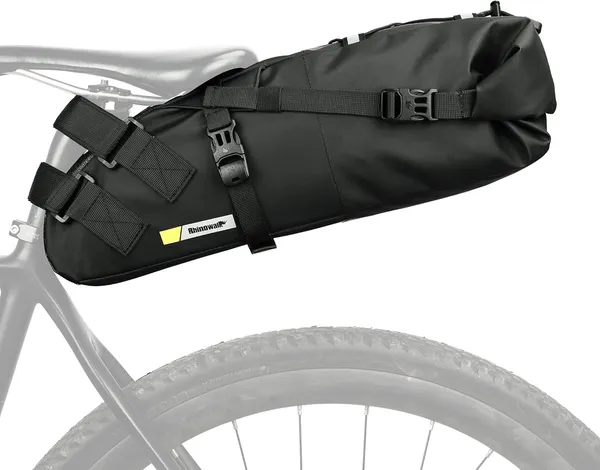
A 10 L Rhinowalk, a 3 L ROCKBROS and an 11 to 13 L KEMIMOTO compared on waterproofing claims, sway, clearance and owner reports. Only two carry overnight kit.
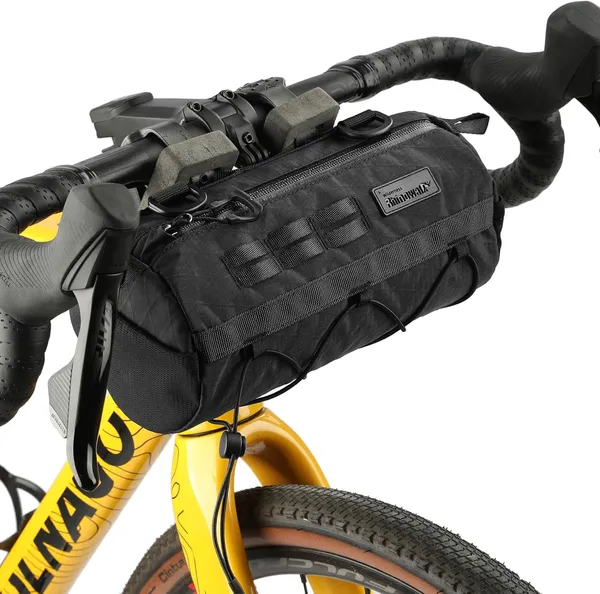
From a 20-litre roll and pouch set for multi-day trips to thermal-insulated lunchboxes for day rides, we compare 8 budget handlebar bags for gravel bikepacking.

Louis runs GravelPacker and is accountable for what it publishes. He wrote the scoring rubric the product reviews are graded against and decides what ships. The pieces under his byline are the desk-research ones: comparisons and explainers built from spec sheets, owner reports and the rubric, not from a test lab.