Seatpack vs Panniers vs Frame Bag: Choosing a Load Layout

This is the decision that costs the most to get wrong, because you make it once and then buy everything else around it. It is also the one nobody explains before selling you a seatpack.

Published August 19, 2026
Edited by Louis Raveton
When you purchase through links on our site, we may earn an affiliate commission. Here's how it works.
Our pick

Ortlieb Seat Pack L

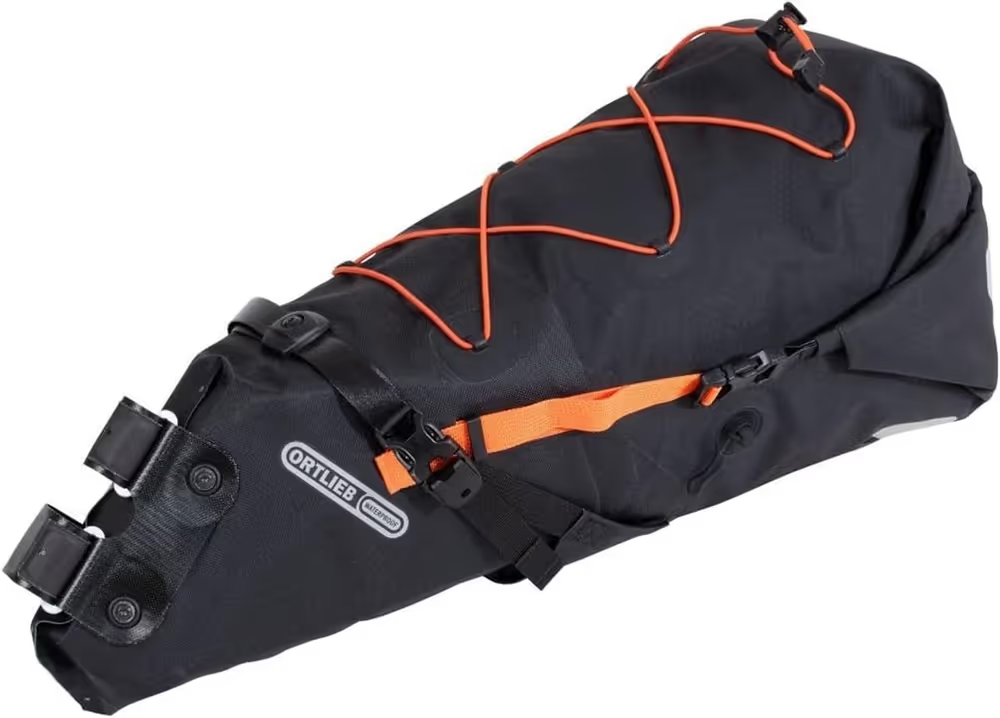
The reference point in the premium market. Waterproofing holds at the seams and the closure, and the mount resists sway under load.

Check price

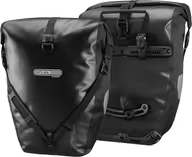
Three bags from three different layouts, chosen because each one is a fair representative of its format rather than a bargain or an outlier. A 16 litre seatpack, a pair of rear panniers, and a full frame bag, judged on what each layout does to the same load.

This is a comparison of approaches rather than products. The specific bags matter less than what their positions on the bike do to how it rides, what they cost to get started with, and how much of your bike they need in order to work at all.

The honest headline is that most riders should own a seatpack and a frame bag, and should buy the frame bag first. That is not the answer the industry advertises, and it is the one the specifications support.

Side by side

  Ortlieb Seat Pack L Ortlieb Back-Roller Classic ROCKBROS Triangle Waterproof Bikepacking Frame Bag
Our score 4.5/5 4.5/5 4.1/5
Price $165.00 $199.00 $37.99
Volume 16L
Weight 456g1.9kg (Set)190g
Waterproof Fully Waterproof
Mounting Heavy Duty Velcro
Min Tire Clearance 15cm
Capacity 40L (Pair)2.5L
Material PVC Coated Polyester600D Polyester + TPU
Feature Quick-Lock 2.1 mounting system
Dimensions 40 x 12.5 x 6 cm

Capacity

Winner: Ortlieb Back-Roller Classic

A pair of rear panniers gives you around 40 litres, against 16 for the seatpack and roughly 3 to 5 for a full frame bag. Nothing else here is close, and the gap widens once you factor in that panniers take rigid, awkwardly shaped objects while a seatpack only really takes soft compressible ones. If you are carrying a week of food, camera gear, or anything with corners, this axis decides the whole comparison on its own.

Handling

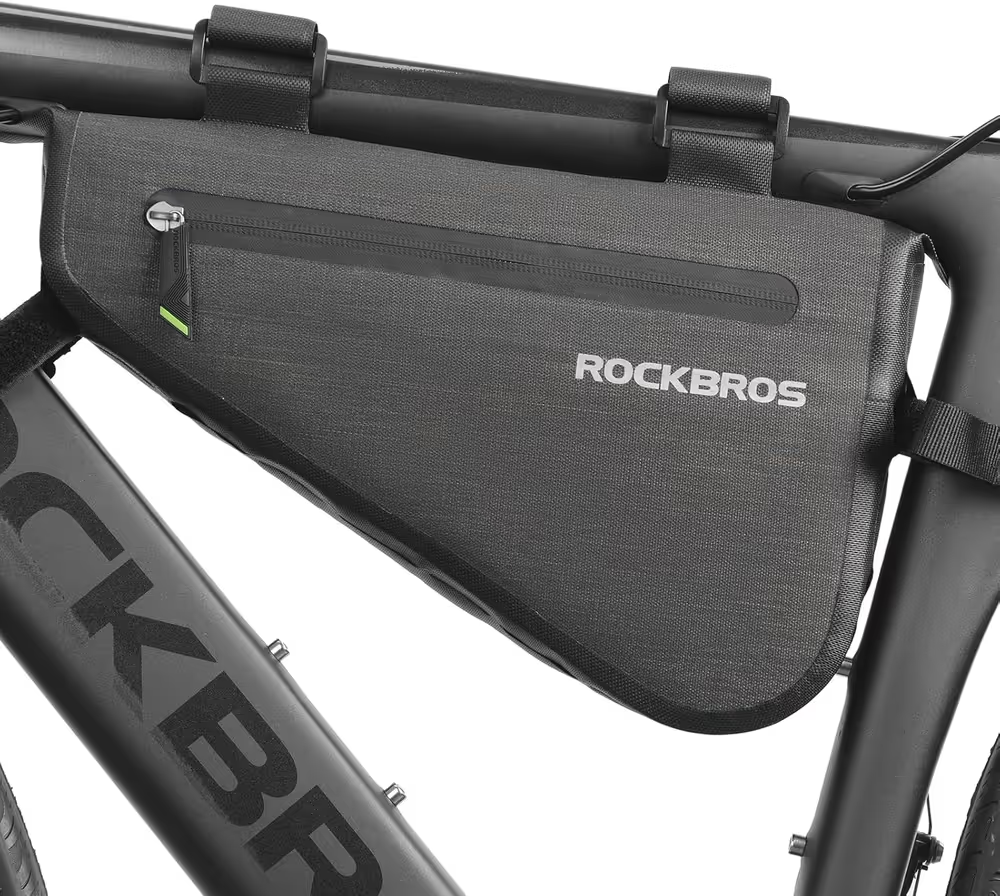
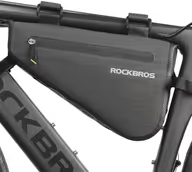
Winner: ROCKBROS Triangle Waterproof Bikepacking Frame Bag

The frame bag puts weight inside the wheelbase and low, which is the best place on a bicycle for it to be. The bike still feels like a bike. Panniers sit low but well behind the rear axle, which makes the back end feel planted on pavement and vague on loose descents. A seatpack is the worst of the three by this measure, because it is a cantilever hanging off the saddle rails and it sways in exact proportion to how badly you packed it.

Off-road tolerance

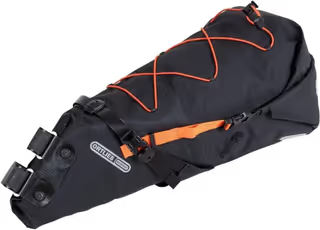
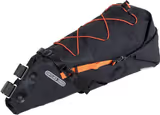
Winner: Ortlieb Seat Pack L

This is where the seatpack earns its place. It needs no mounts, adds no width, and cannot catch on anything, so it survives singletrack, hike-a-bike and overgrown doubletrack without complaint. Panniers add roughly 40 cm of width and hang low enough to strike rocks on rough ground, and a loaded rack is a rattling liability on repeated impacts. The frame bag is close behind the seatpack here, losing only because it competes with bottle mounts.

Cost of entry

Winner: ROCKBROS Triangle Waterproof Bikepacking Frame Bag

A competent frame bag is 28 dollars and needs nothing else. A seatpack is 95 to 200 dollars and also needs nothing else. Panniers are 170 dollars for a good pair plus 40 to 80 for a rack, plus a frame with the mounts to bolt it to, which many modern gravel bikes do not have. Counting the rack honestly, the pannier route is three to seven times the cost of starting with a frame bag.

Ease of packing

Winner: Ortlieb Back-Roller Classic

Panniers open wide, sit at waist height, take rigid objects and let you find things without unpacking everything above them. A seatpack is a tube you fill from one end, so the thing you need is always at the bottom, and every stop means re-compressing it properly or accepting sway for the next hour. The frame bag is easy to access but so narrow that anything wider than a paperback has to go somewhere else.

Bike compatibility

Winner: Ortlieb Seat Pack L

A seatpack fits any bike with a seatpost and 15 cm of clearance under the saddle, including full carbon frames with no mounts anywhere. Frame bags need a triangle large enough to be useful, which small frames and full-suspension bikes do not have, and they usually cost you a bottle cage. Panniers need rack mounts or an adapter, which rules out a large share of modern gravel and all road bikes.

The Question Behind The Question

People ask which bag to buy. The real question is where on the bike the weight should sit, and the three formats give three different answers.

A frame bag puts it inside the wheelbase, low and central. Panniers put it low but behind the rear axle. A seatpack puts it high and well behind the axle, which is the worst place for it from a physics standpoint and the only place available on a bike with no mounts.

That trade is the entire comparison. Everything else, the capacity, the price, the waterproofing, follows from it.

Why the Seatpack Still Wins Overall

It handles worst of the three and it takes the overall pick anyway, which deserves an explanation.

The seatpack wins because it is the only format with no prerequisites. No rack mounts, no frame triangle, no width, no compatibility question. It fits the bike you already own, it carries a full sleep system, and it goes anywhere the bike goes.

The frame bag handles better and costs a fifth as much, but it cannot carry a sleeping bag. Panniers carry more than both combined and need a rack, mounts and 40 cm of width you may not want. If you are buying one item that lets you sleep outside this weekend, it is the seatpack.

[[related:what-size-seatpack-do-i-need]]

The Order That Actually Makes Sense

Buy the frame bag first, for under thirty dollars, and use it for tools, food and water on day rides. You will use it every week regardless of what you do next.

Add a seatpack when you want to sleep out. This is the expensive purchase and it is the one worth measuring your tyre clearance for before you order.

Add panniers only when trip length forces it, which for most riders is never. A rack, mounts and 170 dollars of luggage to carry a week of food is a real solution to a real problem, and it is not the problem a weekend rider has.

[[related:best-bikepacking-seatpacks]]

The Thing All Three Share

None of these formats saves you from packing badly.

A seatpack half-full sways. A pannier with all the heavy things in one side steers the bike. A frame bag with the water at the front changes how the front wheel loads in corners. The layout sets your ceiling and your packing decides how close to it you get.

[[related:5-rookie-bikepacking-packing-mistakes]]

Which one for you

Best all-round starting point Ortlieb Seat Pack L

Fits any bike, survives any surface, and carries a full sleep system. Buy this if you are only buying one thing.

Best first purchase, and the cheapest ROCKBROS Triangle Waterproof Bikepacking Frame Bag

Under thirty dollars, improves how the bike handles, and works alongside whatever you buy next. Start here.

Best for long tours and heavy loads Ortlieb Back-Roller Classic

Forty litres that opens wide and takes rigid gear. Worth the rack if your trips are measured in weeks.

The full reviews

Ortlieb // Best For Ultra Racing

Ortlieb Seat Pack L

Product shot of Ortlieb Seat Pack L by Ortlieb
Best For Ultra Racing

Tech Specs

volume
16L
weight
456g
waterproof
Fully Waterproof
mounting
Heavy Duty Velcro
min tire clearance
15cm
The absolute benchmark of premium, flawlessly engineered bikepacking gear. Brutally dependable waterproofing elegantly paired with legendary sway-free stability.

The Ortlieb Seat Pack L is the benchmark for waterproof bikepacking luggage. While other brands rely on sewn seams and tape, Ortlieb uses high-frequency welding to create a bond that is effectively impenetrable by water. Owner reports after full days of sustained rain describe dry contents, which is not something said about most bags in this category. The built-in air release valve is a standout feature. It lets you purge trapped air while rolling the bag closed, creating a rock-solid, compressed wedge that resists swaying.

Read the full review

Stability is the Ortlieb's greatest strength. The heavy-duty velcro straps and internal stiffeners work together to minimize the "pendulum effect" when you're climbing out of the saddle on steep gravel. The rear elastic bungee is a practical touch for stashing a wet rain shell or a pair of camp shoes. It's built from PU-coated nylon that shrugs off abrasion from mud and road spray without delaminating.

The main drawbacks are the premium price and the requirement for significant vertical tire clearance (at least 15cm). If you have a small frame or low saddle height, this bag may rub on your rear tire. But for riders who need absolute reliability in harsh conditions, it is an investment that pays off over thousands of miles.

The Verdict

The reference point in the premium market. Waterproofing holds at the seams and the closure, and the mount resists sway under load.

GravelPacker score How we score
4.5/5
Durability
5
Performance
5
Usability
4.5
Value
3.5
  • Absolute waterproof reliability
  • Exceptional anti-sway stability
  • Integrated air compression valve
$165.00
At time of review
Buy on Amazon

The Good

  • + Absolute waterproof reliability
  • + Exceptional anti-sway stability
  • + Integrated air compression valve

The Bad

  • Premium price tag
  • Requires significant vertical tire clearance
  • Wider profile may brush thighs
Ortlieb // Best For World Touring

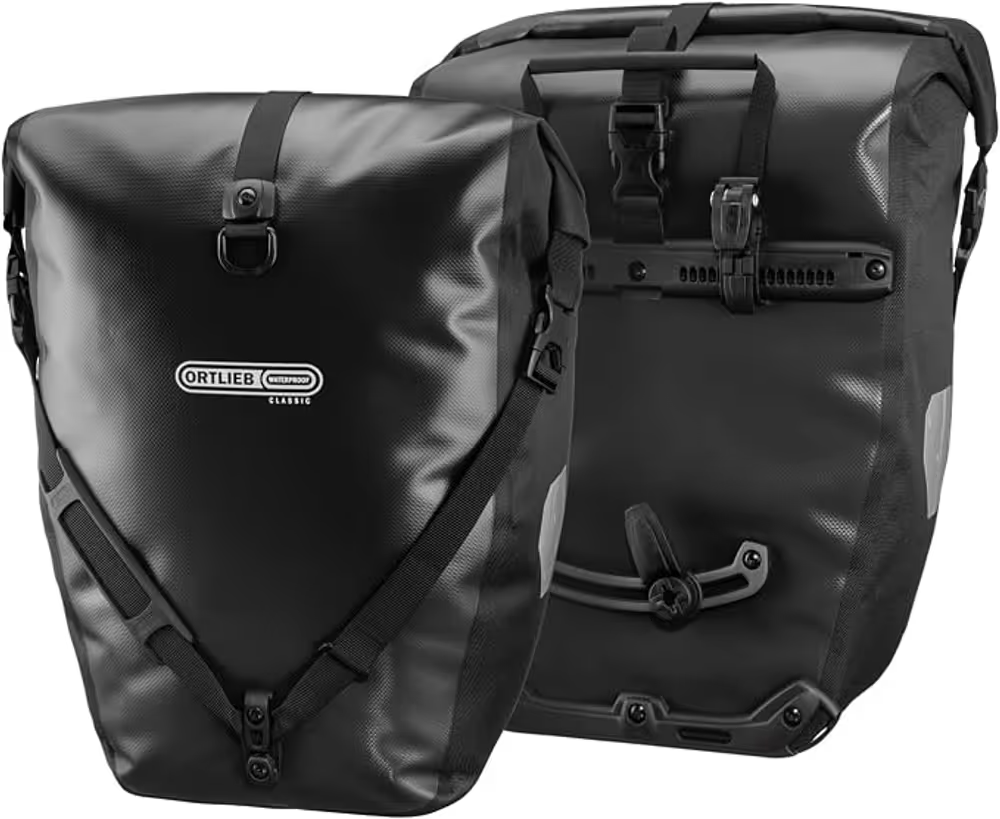
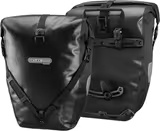
Ortlieb Back-Roller Classic

Product shot of Ortlieb Back-Roller Classic by Ortlieb
Best For World Touring

Tech Specs

Capacity
40L (Pair)
Material
PVC Coated Polyester
Weight
1.9kg (Set)
Feature
Quick-Lock 2.1 mounting system
The Back-Roller Classic isn't just a bag. It is a piece of gear that defines the touring world.

There is a reason you see these bags on almost every long-distance touring bike in the world. The Back-Roller Classic uses a proprietary polyester fabric that is essentially indestructible. The Quick-Lock 2.1 mounting system is the most refined on the market, allowing you to attach and detach the bags in a single, smooth second.

Read the full review

The waterproofing is absolute. Using a roll-top closure and high-frequency welded seams, these bags will survive anything from a desert dust storm to a tropical monsoon. While they are a significant investment at $199 for the pair, they frequently last for decades of hard use. If you want to buy your last set of panniers first, this is the only choice.

The case against it is the price, and it is worth being precise about what the premium actually buys. Against the Kemimoto pair on this same page, also PVC-coated, also welded and also genuinely waterproof, the Ortlieb costs $119 more for 20L less capacity. On the specifications that decide whether your sleeping bag stays dry the two are equivalent, and what the premium buys is the mounting hardware, the warranty and thirty years of owner evidence.

What is not equivalent is the mounting and the lifespan. Quick-Lock 2.1 clamps to the rail and releases with the carry handle, so the bags come off in a second rather than after a strap-tensioning session, and Ortlieb sells replacement hooks, clips and rails individually, which is why twenty-year-old sets are still in service. If you take the bags off daily, or you intend this to be the last pair you buy, that is the argument. If they go on at the start of a tour and come off at the end, the budget set does the same job.

The Verdict

The undisputed benchmark. Reliable, waterproof, and built to last a lifetime.

GravelPacker score How we score
4.5/5
Durability
5
Performance
5
Usability
4.5
Value
3.5
  • Unmatched durability and build
  • Legendary 100% waterproofing
  • Best-in-class mounting hardware
$199.00
Checked Aug 2026
Available with Amazon Prime
Buy on Amazon

The Good

  • + Unmatched durability and build
  • + Legendary 100% waterproofing
  • + Best-in-class mounting hardware

The Bad

  • Premium price point
  • Minimal internal organization
  • Industrial look is not for everyone
ROCKBROS // Best For Frame Storage

ROCKBROS Triangle Waterproof Bikepacking Frame Bag

Product shot of ROCKBROS Triangle Waterproof Bikepacking Frame Bag by ROCKBROS
Best For Frame Storage

Tech Specs

Capacity
2.5L
Weight
190g
Dimensions
40 x 12.5 x 6 cm
Material
600D Polyester + TPU
2.5L of structured, waterproof storage with 11 adjustable mount points.

The ROCKBROS Triangle Frame Bag is the definitive budget choice for riders who need more volume without the bulk of a full-frame bag. With its 3-liter capacity and internal stiffeners, this bag maintains its sleek profile even when stuffed with heavy tools or a mini pump, ensuring it never bulges into your pedaling path. This high-quality gear is designed specifically for the rigors of multi-day bikepacking adventures across varying terrain. It represents a solid investment for anyone looking to build a reliable and ultralight setup without compromising on essential features or durability.

Read the full review

What sets this model apart is the 11 adjustable mounting points, allowing you to bypass bottle cage bosses or cables on almost any frame geometry. The seam-welded TPU-coated nylon is genuinely waterproof, and the dual-sided zippers provide quick access to your map on one side and your tools on the other. This high-quality gear is designed specifically for the rigors of multi-day bikepacking adventures across varying terrain. It represents a solid investment for anyone looking to build a reliable and ultralight setup without compromising on essential features or durability.

The Verdict

A structured, high-volume bargain that outlasts its price tag.

GravelPacker score How we score
4.1/5
Durability
4.5
Performance
4.5
Usability
4
Value
3.5
  • Stiff internal plates
  • 2.5L of structured capacity
  • 11 Mounting hole options
$37.99
Checked Aug 2026
Buy on Amazon

The Good

  • + Stiff internal plates
  • + 2.5L of structured capacity
  • + 11 Mounting hole options
  • + Dual-sided access
  • + Narrow 6cm profile

The Bad

  • Zip pulls can rattle
  • Heavy for a half-bag
  • Tight fit on small frames

Frequently Asked Questions

Can I mix panniers and bikepacking bags?

Yes, and most experienced tourers eventually do. A frame bag plus a single rear pannier is a common setup that gets you low central weight and easy access without the width of a full pair. There is no rule against it, and the idea that you must commit to one system is marketing rather than engineering.

Are panniers really slower?

On pavement, marginally, mostly from the extra width in a headwind. Off road, meaningfully, because the weight sits behind the rear axle and low enough to strike things. The bigger cost is not speed but confidence on loose descents, which is a difference you feel rather than measure.

What if my bike has no rack mounts and a tiny frame triangle?

Then a seatpack plus a handlebar roll is your layout, and it is a good one. This is the situation modern bikepacking luggage was invented to solve, and it is why the seatpack takes the overall pick here despite handling worst of the three.

Which should I buy first?

A frame bag, almost always. It is the cheapest item here by a wide margin, it improves how the loaded bike handles rather than degrading it, and it works alongside anything you buy afterwards. Buying a seatpack first is the more common order and it is the wrong one.

Does a frame bag really only hold 3 to 5 litres?

A half-frame bag on a medium gravel frame is typically 3 to 5 litres, and a full custom triangle bag can reach 8 to 10. That sounds small until you realise it is exactly the right size for tools, food, a filter and a battery, which is most of the dense weight in your kit.
Reviewer

Ryan Cooper

Based in Colorado, Ryan is the guy who spends his Friday nights plotting questionable out-and-back routes. He focuses on practical, budget-conscious setups that work. He's learned the hard way that you don't need a $500 tent to sleep well in the woods.