Bags
Seatpack vs Panniers vs Frame Bag: Choosing a Load Layout
Three ways to carry the same kit, compared on capacity, handling, cost of entry and off-road tolerance. A winner on every axis, and a different one each time.
The honest version of this answer is that you should size the bag to your sleep system, because that is what goes in it. But nobody knows their sleep system volume before they own one, so here is the shortcut that works.
| Trip | Volume | What fits |
|---|---|---|
| Overnighter, bivy or tarp | 8 to 11 L | Quilt, pad, spare layer, toothbrush |
| Overnighter, small tent | 11 to 14 L | The above, with the tent body inside and poles strapped elsewhere |
| Two to three nights | 14 to 17 L | Sleep system, extra layers, two days of food |
| Four nights and up | Rack territory | See below, because this is where seatpacks stop working |
Notice that the jump from one night to three nights is only about 5 litres. Sleep gear is most of the volume and it does not scale with trip length. What scales is food, and food is better in a frame bag where the weight sits low and central.
A seatpack is a cantilever. It hangs off the saddle rails and the seatpost, and every litre you add moves weight further back and further from those two points.
This is why a 17 L bag packed to 10 L sways badly while a 10 L bag packed to 10 L sits still. The empty volume lets the contents shift, and the extra fabric gives that movement somewhere to go. Buying a size up "for flexibility" is the single most common seatpack mistake, and it makes every trip worse rather than only the big ones.
If you cannot fill a bag, you cannot stabilise it. Compression straps reduce the volume but they do not eliminate the leverage, and a half-empty 17 L bag will still wag on a fast, loose descent.
How to Stop Seatpack Sway: The Right Way to Pack Your Tail Bag
A swaying bikepacking saddle bag destroys your cornering and wastes energy. Learn how to pack your tail bag properly to completely kill the pendulum effect.
Before you order anything, take a tape measure and check the gap between your saddle rails and your rear tyre.
Most 10 L seatpacks want 18 cm of clearance when loaded. A packed 15 to 17 L bag wants 22 cm or more, because a fully loaded bag sags several centimetres below where it sits empty. If you ride a small frame, a 29er, or anything with a dropper post, this number and not your trip length is what limits you.
Riders with tight clearance have three options that all work: a smaller seatpack, a rack, or a bag with a rigid harness that holds its shape under load. What does not work is a large soft bag cinched hard and hoped over, because the first time you hit a compression at speed the bag meets the tyre and you learn about friction burns through nylon.
If you already have your sleep kit, skip all of the above and do this instead.
Stuff your quilt or sleeping bag, your pad, and one spare clothing layer into a dry bag. Squeeze the air out and roll it. Measure the roll, or if you cannot be bothered, note the dry bag's litre rating and add three litres of headroom for the odds and ends that always appear.
That number is your seatpack size. It is usually smaller than people expect, and it is why experienced riders often run an 11 L bag on trips where a beginner has bought a 17 L one.
10 Best Bikepacking Saddle Bags (Large 10L+ Seatpacks) for 2026
Ten large bikepacking seatpacks compared on the thing that actually fails: the harness. Which 10L+ saddle bags resist tail sway, and which ones we would not put a loaded bag on.
Buy the smallest bag your sleep system fits in. Put the food and the heavy items in a frame bag, not behind the saddle. Measure your tyre clearance before you order, not after the bag arrives.
And if you find yourself wanting more than 17 litres back there, the answer is not a bigger seatpack. It is a rack.
For an overnighter, yes, if your sleep system is compact. A 10 L bag comfortably takes a quilt, an inflatable pad and a change of clothes. It will not take a two-person tent as well, so the tent goes on the handlebars or the trip becomes a bivy trip.
Measure from the saddle rails straight down to the tyre. Most 10 L bags want at least 18 cm, and a fully loaded 15 to 17 L bag wants 22 cm or more. Small frames and long-travel dropper posts are where this goes wrong, and no strap tension fixes a bag that touches the tyre.
Almost always because it is packed loose or packed light at the back. A seatpack is a lever hanging off two contact points, so any air inside becomes movement. Pack heavy items hard against the seatpost and fill every void before you tighten the compression straps.
Under 17 litres, a seatpack is lighter, faster and works on frames with no mounts. Above that, a rack carries the weight lower and does not sway, at a cost of roughly a kilo and needing somewhere to bolt it. The crossover point is trip length, not preference.
Three ways to carry the same kit, compared on capacity, handling, cost of entry and off-road tolerance. A winner on every axis, and a different one each time.
Three large seatpacks compared on sway, waterproofing, camp packing, tyre clearance, weight and price per litre. A winner named on every one.
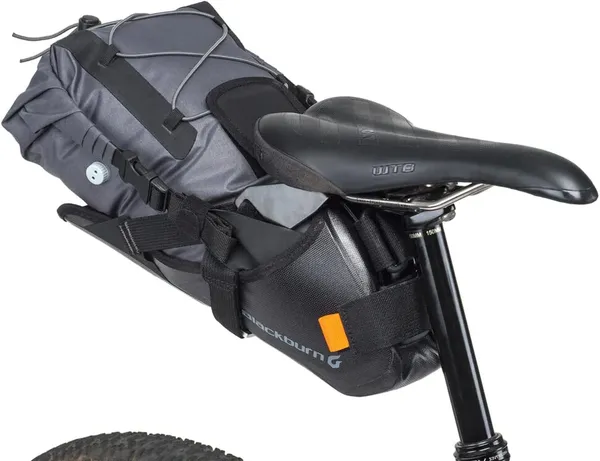
An alloy rail wing, a bolt-on brace and a stiff holster, compared on sway, clearance, fitting and hardware. Only one is built around a dropper post.

Louis runs GravelPacker and is accountable for what it publishes. He wrote the scoring rubric the product reviews are graded against and decides what ships. The pieces under his byline are the desk-research ones: comparisons and explainers built from spec sheets, owner reports and the rubric, not from a test lab.