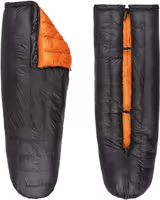
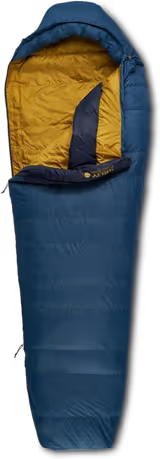
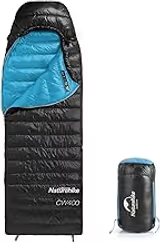
Quilt vs Sleeping Bag for Bikepacking

Quilts win on paper, and they still leave some riders cold. Which group you are in comes down to how you sleep, not how you ride.

Last Updated October 6, 2026
When you purchase through links on our site, we may earn an affiliate commission. Here's how it works.
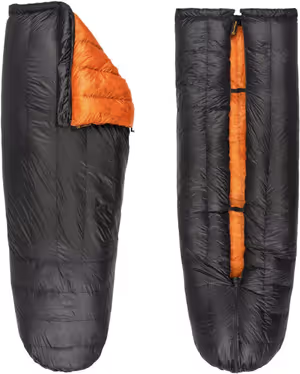
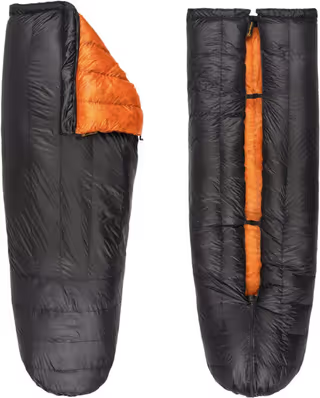
Featherstone Moondance 25 850FP Down Quilt
Our pick

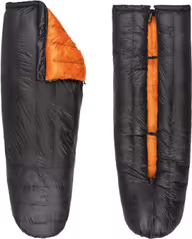
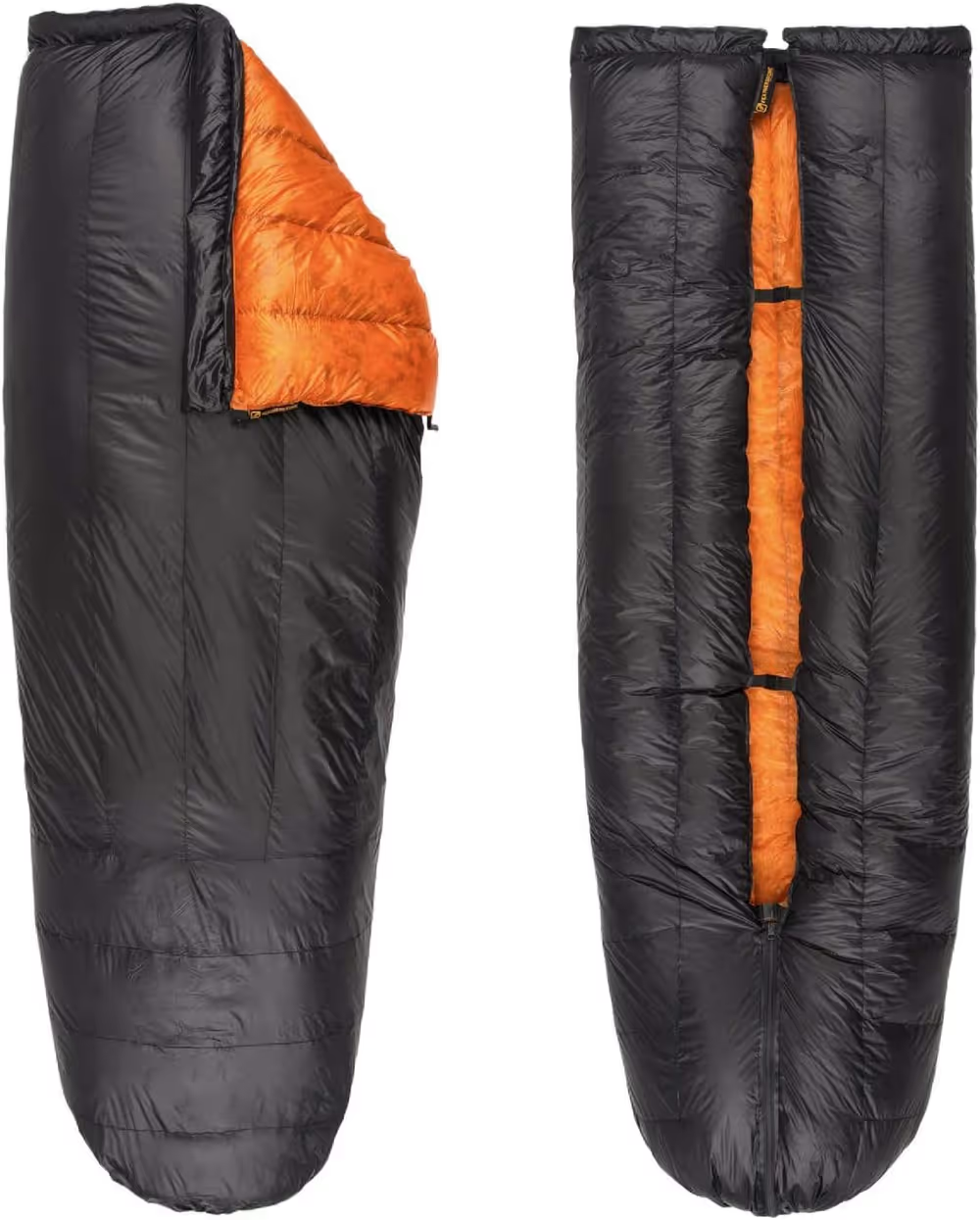
Featherstone Moondance 25 850FP Down Quilt

The strongest paper case of any quilt we found on Amazon: 850FP down, a draft collar and an independently tested rating at about 650 g. Treat the 10D fabric with care, and size up if you are tall.

View on Amazon

A quilt is a sleeping bag with the back removed, on the theory that down compressed under your body does nothing anyway. That theory is correct, and the weight saved is real, and quilts still make some people miserable.

These three cover the honest range of the decision. An 850FP quilt at about 270 dollars list, a hooded 550FP down bag at about 190 dollars list, and a hybrid down bag at around 120 dollars.

The overall pick here is the quilt, because on a bike you usually run out of litres before you run out of grams. The bag is the right answer for one kind of sleeper, and most of the axes below come down to what happens when you roll over.

Side by side

  Featherstone Moondance 25 850FP Down Quilt Kelty Cosmic Down 20 Sleeping Bag Naturehike CW400 Down Sleeping Bag
Our score 4.1/5 3.9/5 3.9/5
Price — — —
Fill 450 g, 850FP DownTek water-resistant grey duck down (Regular)464 g, 550FP RDS down (Regular)400 g, 650FP white duck down
Weight 652 g / 1 lb 7 oz (Regular, maker's figure)1,105 g / 2 lb 7 oz (Regular, maker's figure)910 g (Regular)
Temperature Rating 2°C Comfort / -3°C Limit (ISO 23537-1, independent lab)-0.5°C (31°F) Comfort / -6°C (21°F) Limit (ISO, as listed by REI), sold as 20°F / -7°C4.7°C Comfort / -0.4°C Limit
Shell 10D DWR nylon outer, 10D calendered nylon innerRecycled 20D nylon taffeta and recycled 50D polyester taffeta, PFAS-free DWR20D 400T ripstop nylon
Shape Tapered quilt, box baffles, snap draft collar, zippered cinch footbox, 2 pad strapsHooded mummy cut with expanded footbox, trapezoidal baffles, full draft tube and collar, dual locking slidersMummy upper, rectangular lower, YKK two-way zip
Sizes Regular 192 cm (riders to 178 cm), Long/Wide 229 cmShort to 168 cm, Regular to 183 cm, Long to 198 cmRegular 210 x 75 cm, Large 220 x 85 cm
Packed 33 x 10 cm compressed (maker's figure)20 x 33 cm stuff sack (Regular, maker's figure)35 x 18 x 18 cm (maker's figure)
Buy View on Amazon View on Amazon View on Amazon

Warmth per gram

Winner: Featherstone Moondance 25 850FP Down Quilt

The Moondance is about 650 g for an ISO comfort rating of 2°C on 850FP down. The Kelty is about 1.1 kg for a comfort rating of -0.5°C, and the Naturehike about 910 g for a much warmer 4.7°C. Two and a half degrees of extra comfort costs the Kelty roughly 450 g, close to half a litre of water, and this is the axis quilts were designed to win.

Draft management

Winner: Kelty Cosmic Down 20 Sleeping Bag

A hooded bag has no draft problem because it is a closed tube that moves with you, and the Kelty adds a full draft tube along the zip and a collar at the shoulders. The Moondance has a snap-closed draft collar and two pad straps, a better set than many quilts carry, and it still asks you not to break the seal when you turn over. The Naturehike seals like a bag when zipped and drafts like a blanket the moment you open it to vent.

Packed size

Winner: Featherstone Moondance 25 850FP Down Quilt

Featherstone quotes 33 x 10 cm compressed for the Moondance, against a 20 x 33 cm stuff sack for the Regular Kelty and 35 x 18 x 18 cm for the CW400. The quilt figure is hard-compressed and the Kelty figure is a relaxed stuff sack, so the true gap is smaller than those numbers suggest, but 850FP down against 550FP and 650FP still settles it. On a bike, where volume runs out before weight does, this axis matters more than it does for hikers.

Durability

Tie

Neither bag asks for the care a 10D quilt does. The Naturehike has a 20D 400T ripstop shell, and the Kelty pairs recycled 20D nylon with 50D polyester taffeta, although two REI owners report seams leaking down within a couple of trips. The Moondance uses 10D nylon inside and out, thin enough that one Amazon owner describes seeing the down through it, so it wants a groundsheet between it and gravel.

Ease of use

Winner: Kelty Cosmic Down 20 Sleeping Bag

You get into a sleeping bag and it works, and the Kelty's hood and draft collar need no learning, even if some REI owners find its zip sticks when worked from inside. A quilt has a learning curve in strap tension, footbox cinch and how to tuck the edges, and some Moondance owners on Amazon describe the pad straps as awkward until they worked them out. The Naturehike splits the difference with a mummy-cut top, a rectangular foot end and a two-way zip, so it vents like a quilt on a warm night and closes like a bag on a cold one.

Value

Winner: Naturehike CW400 Down Sleeping Bag

At around 120 dollars for 400 g of 650FP duck down, the CW400 is the cheapest route to real down here, and its open foot end lets you find out how warm you actually sleep. Its 4.7°C comfort rating makes it a summer and shoulder-season piece rather than a cold-weather one. The Kelty is the better cold-night bag and the Moondance, at more than twice the price, the better bikepacking piece, but the CW400 is the better first purchase.

What The Quilt Argument Gets Right

Down under your body is compressed flat and contributes little. Removing it saves real weight, and the Moondance weighs about 650 g against the Kelty's 1.1 kg.

Part of that gap is fill power rather than shape. The two carry almost the same weight of down, 450 g against 464 g, but 850FP lofts about half as much again as 550FP, and the quilt puts all of it on top of you.

That is not marketing. It is the same reason your sleeping pad's R-value matters more than your bag rating on cold ground: the insulation beneath you is doing a different job, and a bag is carrying material that cannot do it.

Related Read

Fill Power Explained: What 640 vs 800 Actually Buys You

Two bags in our catalogue are rated to the same -5°C and cost within a dollar of each other. One weighs 950g and the other 530g. The difference is fill power, and this is what it is worth.

If you sleep still, if you are willing to learn a strap system, and if litres are a genuine constraint, a quilt is straightforwardly better and this comparison is easy.

What It Gets Wrong For Some People

The rating on a quilt assumes the seal holds. Roll over hard, or set the straps loose, and you have opened a gap along your whole side.

A hooded bag simply does not have this failure mode. It is a closed tube, it moves with you, and it delivers its rating whether you are a still sleeper or a restless one. That reliability is the whole case for the Kelty, and it is why it is the pick for restless sleepers despite being the heaviest and bulkiest thing here.

The people who regret buying a quilt are rarely the people who researched it badly. They are the people who turn over a lot.

Related Read

Cold Feet at 4 AM: The Emergency Sleep System Boost

When the temperature drops below your quilt's rating, the 4 AM shivers are inevitable. Six ways to add real warmth to a bag that's underrated for the night you're having.

The Pad Matters More Than You Think

A quilt makes your sleeping pad more important, not less.

With a bag, a low R-value pad costs you some warmth. With a quilt, it costs you all of the insulation on that side, because there is nothing else there. Pairing a 270 dollar quilt with an R1.5 summer pad is an expensive way to have a cold night.

If you are moving to a quilt, budget for the pad in the same purchase.

Related Read

The Best Sleeping Pads for Bikepacking (2026)

Eight sleeping pads from $40 to $229, judged on R-value, packed size and how they behave in a seatpack. The spec that matters is the one nobody reads.

The Cheap Way To Decide

Buy the 120 dollar hybrid first.

The Naturehike closes like a mummy bag at the shoulders and opens from the feet, which means one summer of venting it tells you more about your own sleeping than any amount of reading. If you find yourself unzipping it every night, buy the Moondance with confidence. If you keep it zipped and still want a warmer bag for October, the Kelty is the one to look at.

That is a better use of 120 dollars than most gear purchases on this site.

Which one for you

850FP down, a draft collar and an independent ISO rating at about 650 g. It leaves room in a seatpack that a bag would fill, if you sleep reasonably still.

View on Amazon
Best if you turn over all night Kelty Cosmic Down 20 Sleeping Bag

A closed, hooded bag with an ISO comfort rating just below freezing. About 450 g heavier and far bulkier than the quilt, and it delivers its rating however you sleep.

View on Amazon
Best way to find out which you prefer Naturehike CW400 Down Sleeping Bag

About 120 dollars for real down, with a foot end you can open. Learn how warm you sleep before spending more than twice that on a quilt.

View on Amazon

The full reviews

Featherstone // Best For Shoulder Season //
★ 4.6 (349 ratings at the retailer)

Featherstone Moondance 25 850FP Down Quilt

Product shot of Featherstone Moondance 25 850FP Down Quilt by Featherstone
Best For Shoulder Season

Tech Specs

Fill
450 g, 850FP DownTek water-resistant grey duck down (Regular)
Weight
652 g / 1 lb 7 oz (Regular, maker's figure)
Temperature Rating
2°C Comfort / -3°C Limit (ISO 23537-1, independent lab)
Shell
10D DWR nylon outer, 10D calendered nylon inner
Shape
Tapered quilt, box baffles, snap draft collar, zippered cinch footbox, 2 pad straps
Sizes
Regular 192 cm (riders to 178 cm), Long/Wide 229 cm
Packed
33 x 10 cm compressed (maker's figure)
Most quilts this light are built to order by cottage makers, and few carry a lab rating. The Moondance has 850FP down, a draft collar and ISO figures from an independent lab, and it is sold off the shelf on Amazon.

The Regular Moondance 25 puts 450 g of 850FP water-resistant grey duck down into a quilt Featherstone lists at 1 lb 7 oz, about 652 g. Its ISO 23537-1 figures are 2°C comfort and -3°C limit, and both Featherstone and SectionHiker's review say they come from an independent lab. That is unusual at this price, where many quilts carry a brand rating with no test behind it.

Read the full review

The feature set matches the premium cottage quilts, with box baffles, a draft collar that snaps behind the neck and a zippered footbox that cinches shut or opens to vent. SectionHiker notes that Enlightened Equipment and Hammock Gear leave the draft collar off their ready-made economy quilts. Featherstone quotes 33 x 10 cm compressed, small for a quilt this warm, though that is a hard-compressed figure rather than a relaxed stuff sack.

The friction is in the fabric and the fit. Shell and lining are both 10D nylon, thin enough that one Amazon owner describes seeing the down through it, so it wants a groundsheet or bivvy between it and a gravel pitch. Featherstone sizes the Regular for riders up to 178 cm, and owners near that height disagree about whether to size up to the 229 cm Long/Wide.

Owner reports on Amazon US were strong when we checked in October, 4.6 stars across 349 ratings with 1% at one star. The complaint that recurs is the pad straps, which some owners found awkward until they worked out the buckles, and SectionHiker's review notes the straps are plain webbing rather than elastic.

The Verdict

The strongest paper case of any quilt we found on Amazon: 850FP down, a draft collar and an independently tested rating at about 650 g. Treat the 10D fabric with care, and size up if you are tall.

GravelPacker score How we score
4.1/5
Durability
3.5
Performance
4.5
Usability
4
Value
4.5
  • • 850FP down with an independent ISO rating
  • • Draft collar and zippered venting footbox
  • • About 650 g for a -3°C limit

The Good

  • + 850FP down with an independent ISO rating
  • + Draft collar and zippered venting footbox
  • + About 650 g for a -3°C limit

The Bad

  • − 10D shell and lining need care
  • − Regular only fits riders to 178 cm
  • − Pad straps take practice to master
Kelty // Best For Cold Nights //
★ 4.6 (110 ratings at the retailer)

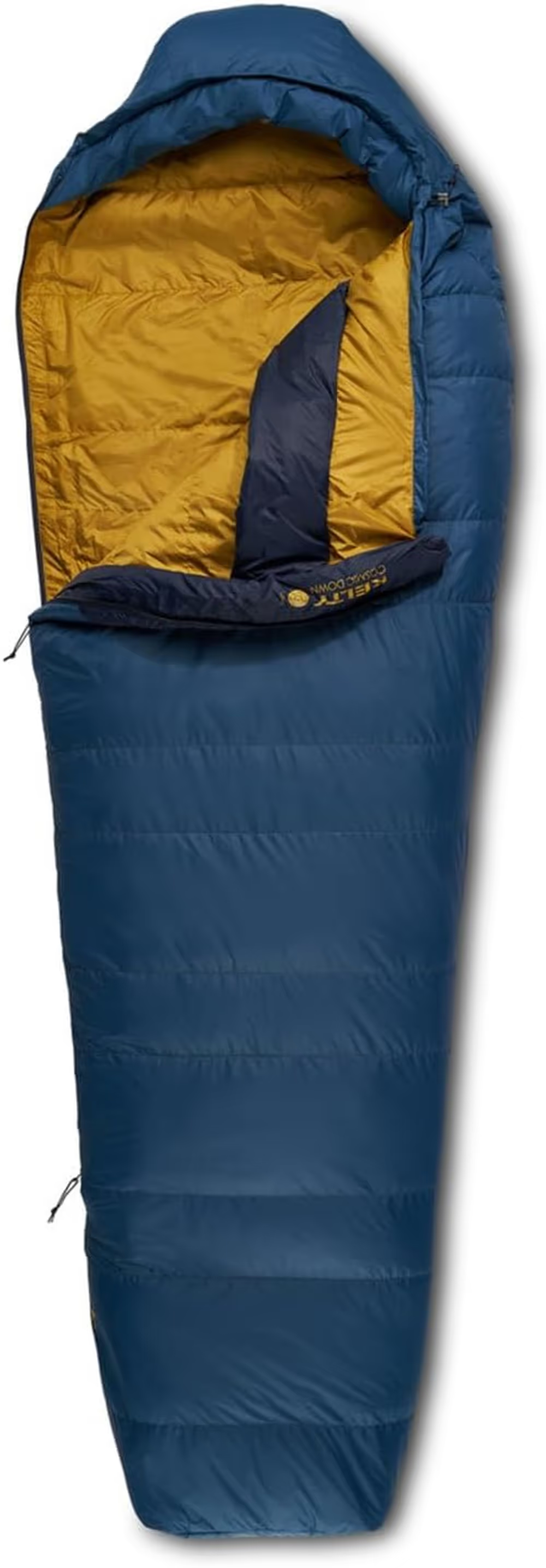
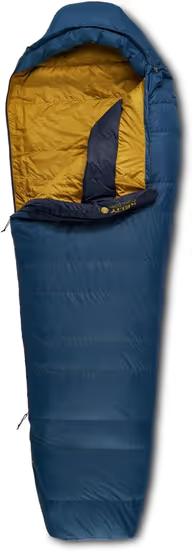
Kelty Cosmic Down 20 Sleeping Bag

Product shot of Kelty Cosmic Down 20 Sleeping Bag by Kelty
Best For Cold Nights

Tech Specs

Fill
464 g, 550FP RDS down (Regular)
Weight
1,105 g / 2 lb 7 oz (Regular, maker's figure)
Temperature Rating
-0.5°C (31°F) Comfort / -6°C (21°F) Limit (ISO, as listed by REI), sold as 20°F / -7°C
Shell
Recycled 20D nylon taffeta and recycled 50D polyester taffeta, PFAS-free DWR
Shape
Hooded mummy cut with expanded footbox, trapezoidal baffles, full draft tube and collar, dual locking sliders
Sizes
Short to 168 cm, Regular to 183 cm, Long to 198 cm
Packed
20 x 33 cm stuff sack (Regular, maker's figure)
A hooded down bag with an ISO comfort rating just below freezing, at under 200 dollars list. The 550FP down is why it weighs 1.1 kg and packs to around 10 litres, and that is the whole trade.

The Regular Cosmic Down 20 holds 464 g of 550FP down in a bag Kelty lists at 2 lb 7 oz, about 1.1 kg. Kelty sells it as a 20°F (-7°C) bag, the ISO figures REI lists are 31°F (-0.5°C) comfort and 21°F (-6°C) limit, and the Amazon listing gives the same 21°F limit. The comfort figure is the one to plan around, and it makes this a near-freezing bag rather than a summer one.

Read the full review

It is a closed tube with a hood, a full draft tube along the zip and a draft collar at the shoulders, so it keeps its warmth when you roll over. Two locking sliders let you open it from the feet on a mild night. Kelty calls the cut semi-rectangular and REI calls it a mummy, and the Regular's 158 cm shoulder girth is roomier than a close-cut mummy, though one heavier Amazon owner still found it tight across the arms.

The cost on a bike is volume. Kelty's stuff sack for the Regular measures 20 x 33 cm, roughly 10 litres, which is most of a 14 litre seatpack before the pad goes in, and 550FP down needs more space than higher fill power down for the same warmth. Riders with a large bar roll can carry it there, and riders on a small seatpack should look at a quilt instead.

Owner reports on Amazon US sat at 4.6 stars across 110 ratings for the Regular when we checked in October, and REI's own reviews were cooler at 3.8 stars across 49. The REI complaints we read centre on a zip that sticks when worked from inside, and two one-star reports describe seams leaking down within a couple of trips. The Amazon listing says Kelty covers the bag with a limited lifetime warranty.

The Verdict

A warm, closed, forgiving bag at a fair list price, with the bulk that 550FP down brings. Buy it for restless sleep and cold nights, not for a small seatpack.

GravelPacker score How we score
3.9/5
Durability
3.5
Performance
3.5
Usability
4
Value
4.5
  • • ISO comfort near 0°C, with a hood
  • • Draft tube and collar block drafts
  • • Fair list price for tested down

The Good

  • + ISO comfort near 0°C, with a hood
  • + Draft tube and collar block drafts
  • + Fair list price for tested down

The Bad

  • − 1.1 kg is heavy for bikepacking
  • − Roughly 10 litre stuff sack size
  • − Some owners report a sticking zip
Naturehike // Best For Summer Touring //
★ 4.3 (184 ratings at the retailer)

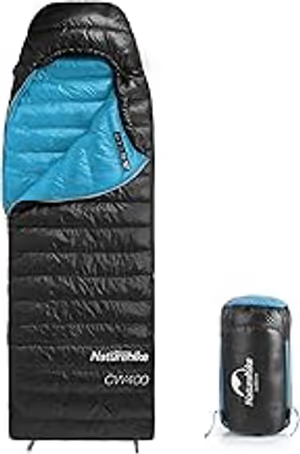
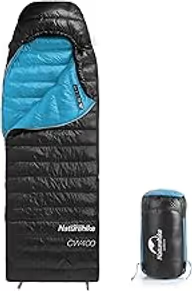
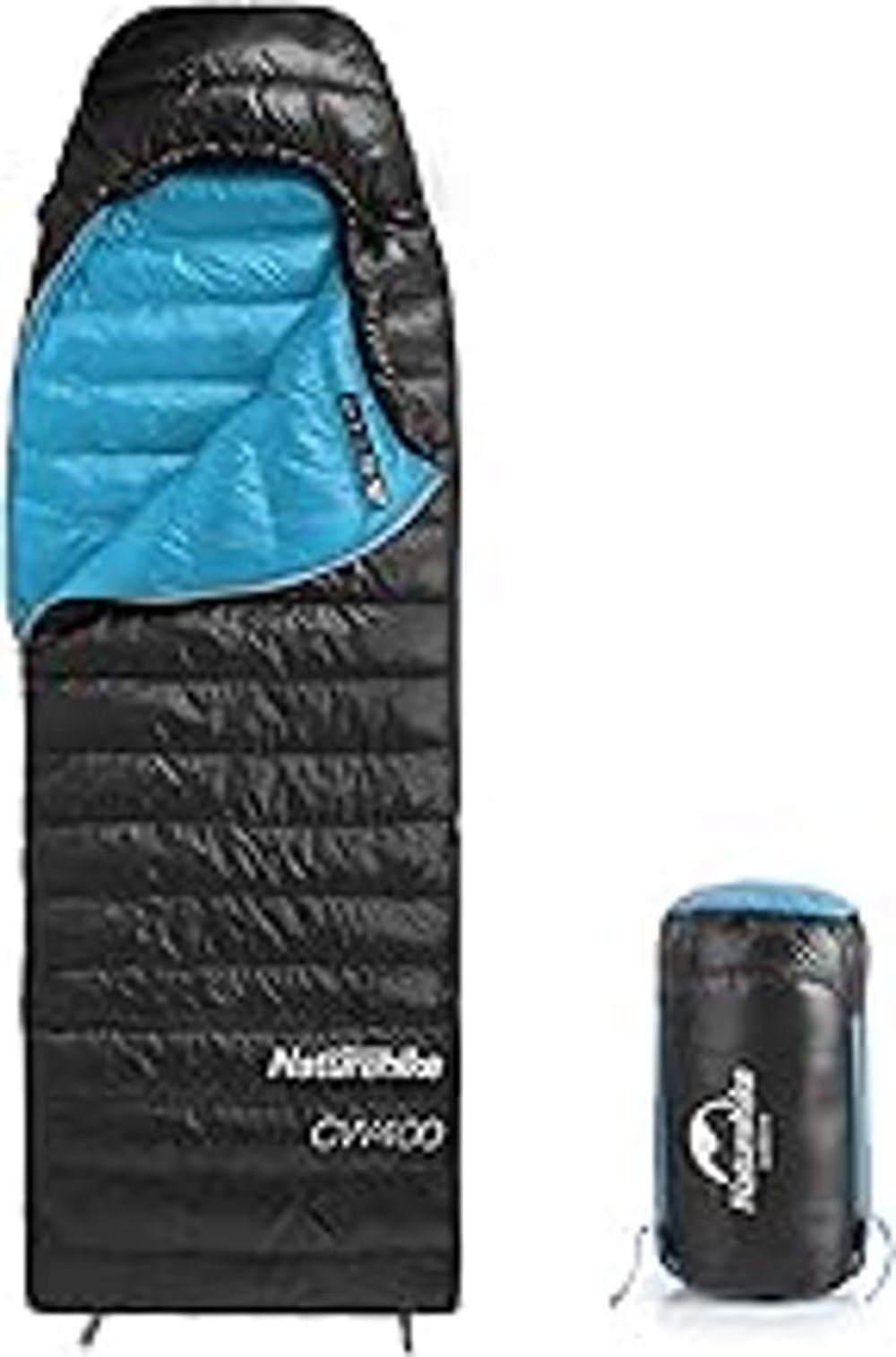
Naturehike CW400 Down Sleeping Bag

Product shot of Naturehike CW400 Down Sleeping Bag by Naturehike
Best For Summer Touring

Tech Specs

Fill
400 g, 650FP white duck down
Weight
910 g (Regular)
Temperature Rating
4.7°C Comfort / -0.4°C Limit
Shell
20D 400T ripstop nylon
Shape
Mummy upper, rectangular lower, YKK two-way zip
Sizes
Regular 210 x 75 cm, Large 220 x 85 cm
Packed
35 x 18 x 18 cm (maker's figure)
A 20D-shell down bag at around 120 dollars, with a foot end you can open. It is heavier than its rating suggests, and that is the trade you are making.

The current CW400 carries 400 g of 650FP duck down in a bag of about 910 g, rated 4.7°C comfort and -0.4°C limit. Older listings under the same name describe a lighter 750FP goose version, so check the fill power on the listing you are actually buying. The shape is the selling point: mummy at the shoulders, rectangular from the hips down, with a YKK two-way zip.

Read the full review

The 20D 400T shell is more than twice the thickness of the 7D and 10D fabrics on Aegismax's bags, which matters when a bag goes straight onto a bivvy floor. The price of that toughness, and of 650FP down, is bulk. At 35 x 18 cm stuffed it is a seatpack or a large bar roll on its own, not a corner of one.

Owner reports on Amazon US sat at 4.3 stars across 184 ratings when we checked. Whatever the build quality, a 4.7°C comfort rating means a cold night near freezing needs a liner or a down jacket inside it. Treat it as a late-spring to early-autumn bag and it is good value.

The Verdict

Honest value down with a forgiving shape. It is a 5°C bag that weighs like a 0°C one, so buy it for the price and the shell, not the numbers.

GravelPacker score How we score
3.9/5
Durability
4
Performance
3.5
Usability
4
Value
4
  • • Two-way zip vents from the feet
  • • Tough 20D shell for bivvy nights
  • • Rectangular foot end, room to move

The Good

  • + Two-way zip vents from the feet
  • + Tough 20D shell for bivvy nights
  • + Rectangular foot end, room to move

The Bad

  • − 910 g for a 4.7°C comfort
  • − Bulky 650FP down eats seatpack space
  • − Two versions sold under one name

Frequently Asked Questions

Are quilts actually warmer than sleeping bags?

For the same weight, yes, because none of the down is wasted compressed under you. For the same rating on the label, they are equal in theory and often colder in practice, because the rating assumes no drafts and a quilt only achieves that if the straps are set correctly and you sleep reasonably still.

Can I compare a quilt's temperature rating with a bag's?

Only when both are tested to the same standard, and many quilts are not. The Moondance is unusual in publishing ISO 23537-1 figures from an independent lab, 2°C comfort and -3°C limit, which can sit beside the Kelty's ISO figures of -0.5°C and -6°C. Even then, a quilt only matches its figure in the field when its edges stay sealed to a decent pad.

Do quilts work for side sleepers?

Yes, better than for restless sleepers. The problem is not the position, it is the transition: every time you roll over you can break the seal between quilt and pad and pull in cold air. Side sleepers who settle in one position do fine. People who turn over ten times a night do not.

What temperature rating do I need for bikepacking?

Rate for the coldest night you will realistically have, not the average. In most three-season riding that means a 0°C comfort rating, which handles a clear night at altitude in August as well as a damp one in October. Buying for the daytime temperature you set off in is how riders end up with cold feet.

Is a 20D shell worth the weight over 10D?

On a bike, usually yes. Bikepacking gear gets stuffed into tight bags, dragged out at trailheads and used on gravel rather than forest floor. A shell you do not have to be careful with is worth some weight for most riders, and here the Naturehike and the Kelty both use 20D fabric while the Moondance is 10D throughout.

Can I use a quilt below freezing?

A well-strapped quilt with an appropriate rating handles freezing nights fine, and plenty of people do it. What it does not tolerate is a sloppy setup, an underinflated pad or a low R-value one. Below freezing the pad matters as much as the quilt, and a quilt punishes a bad pad far more than a bag does.
Reviewer

Louis Raveton

Louis runs GravelPacker and is accountable for what it publishes. He wrote the scoring rubric the product reviews are graded against and decides what ships. The pieces under his byline are the desk-research ones: comparisons and explainers built from spec sheets, owner reports and the rubric, not from a test lab.